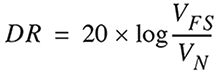
As the measured vibrations in an ODS test are often unknown, it is important to pay special attention to avoiding overloads and under-range situations. Much can be done by constantly doing trial runs and changing input attenuators accordingly. But for higher efficiency and data quality, the best solution is to use a data acquisition system with a high dynamic range matching the transducers used.
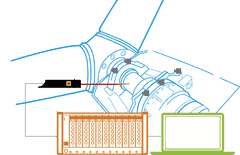
Also, when performing ODS tests on large structures such as large machinery, ships, trains, bridges, and buildings the cabling task can be immense. To reduce cabling cost, make the test setup simpler, and to eliminate the risk of errors, it can be very advantageous to use distributable data acquisition hardware that can be located close to the measurement points and connected either through simple standard LAN cables or wireless.
When performing ODS tests on large structures, the first vibration patterns of interest might be at quite low frequencies, close to 0 Hz. Consequently, both the data acquisition hardware and accelerometers must support measurements down to DC in these cases.
Regarding accelerometers, many of the requirements for other structural tests such as modal testing apply here as well. Parameters to consider range from dynamic range, frequency range, and sensitivity, to low weight to avoid mass loading and easy mounting using accessories such as clips and bases. Specific requirements such as high-temperature range, hermetic sealing, robustness, etc., might apply as well.