Dynamic Range of Transducers
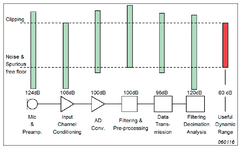
Before the Dyn-X technology was introduced in 2005, the sound and vibration transducers have outperformed the subsequent analysis systems as regards linearity and dynamic performance.
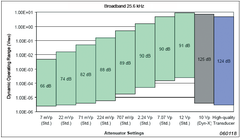
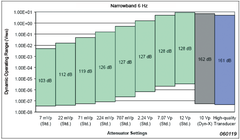
A high-quality transducer, including a preamplifier, can deliver a practical noise-, spurious- and distortion-free signal over a dynamic range of 120 to 130 dB using broadband, and 160 dB using narrowband analysis. In a well-designed transducer, the limiting factors for achieving a high dynamic range are mainly the noise floor and the clipping level of the preamplifiers electronics.
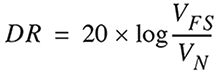
The transducer element itself does not limit the performance. The noise floor VN of a high-quality preamplifier has for the last 40 to 50 years been in the region of 3 µV to 15 µV in the audible frequency range and the maximum linear output VFS of a DeltaTron®/ICP® transducer is 5 VRMS (7.071 Vpeak). Table 1 provides examples of dynamic ranges that can be expected for a high-quality transducer.
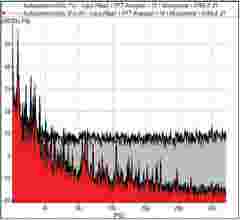
Throughout this article, a bandwidth of 25.6 kHz is used for broadband comparisons. For narrowband comparisons 24 Hz, 6 Hz, and 1Hz are used, where, for example, 6Hz corresponds to the effective noise bandwidth of a 25.6 kHz FFT analysis with 6400 lines using Hanning weighting [1]. So, a high-quality transducer can be used for narrowband measurements over a dynamic range of 160 dB (effective noise bandwidth 6 Hz) given that no other factors affect the measurement chain.
| Bandwidth (Hz) | 25600 | 1024 | 24 | 6 | 1 |
|---|
| VFS (VRMS) | 5 |
|---|
| VN (VRMS) | 3u | 600n | 92n | 46n | 19n |
|---|
| DR (dB) | 124 | 138 | 155 | 161 | 169 |
|---|
Table 1. Dynamic ranges for a high-quality DeltaTron/ICP transducer