MAIN MENU

Industrial machinery generates more data than ever before. Yet machine builders face a growing paradox: while the volume of available data continues to increase, actionable process insight can remain difficult to extract.


Modern weighing systems continuously generate valuable measurement data.
When machine performance deteriorates, giveaway increases or process deviations occur, more data rarely provides the answer on its own. The challenge is no longer simply data acquisition. It is transforming reliable weighing data into information that enables faster troubleshooting, improved machine performance, and more efficient service operations.

In Weighing 4.0, the defining challenge is therefore not generating more data but extracting actionable process insight from the measurements already available.

From Compliance Check to Process Diagnostic

Industrial weighing is often viewed primarily in terms of the result it delivers: does the product or process meet its target weight?

In a connected production environment, however, the value of weighing data can extend far beyond an individual result. Changes in weight signals over time can provide information about how a machine is behaving, how stable a process remains, and whether performance is beginning to deviate from its expected operating condition.

A single weight value confirms what happened at one point in the process. A sequence of measurements can reveal trends, increasing variability, or changes in process behaviour that would be difficult to identify from an isolated value. For machine builders, this expands the role of weighing technology beyond measurement and quality control, turning it into a source of process diagnostics.

When weighing data is combined with relevant machine and process context,  such as product, recipe, batch, machine state, or cycle information, emerging deviations can be identified earlier, troubleshooting can become more targeted, and new service capabilities can be enabled. This is where the measurement chain becomes strategic. Value no longer depends solely on sensor accuracy, but on the ability to preserve measurement integrity, process the data and make it usable throughout the data chain.


The result is a fundamental shift: from measuring products to understanding processes.



ENGINEERING INSIGHT

Industrial analytics starts with measurement quality. Before asking what an algorithm can learn from the data, engineers need to know whether the physical measurement is accurate, repeatable, and relevant to the process decision.

One Measurement, Two Different Data Needs

Extracting greater value from weighing data creates another challenge: the same measurement may now need to serve multiple systems with fundamentally different requirements.

Historically, weighing electronics were primarily integrated into localised control loops. A load cell provided the measurement signal to the weighing electronics, which communicated with the PLC to support real-time machine and process control. That architecture remains essential. But in a Weighing 4.0 environment, a single destination for measurement data is no longer always sufficient.

The same weight information may need to support deterministic machine control while also contributing to process monitoring, traceability, production analysis, or enterprise-level applications.

These requirements create two distinct but complementary data paths.


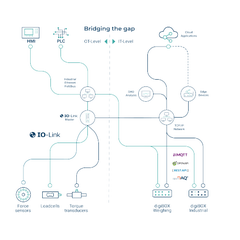
OT – Real-Time Control

Operational Technology requires low-latency, deterministic communication to support machine control and process execution. Industrial Ethernet protocols such as PROFINET or EtherNet/IP are designed to address these time-critical requirements.


IT – Process Intelligence

Information Technology typically requires selected, aggregated, and contextualised information rather than every high-frequency measurement. Protocols such as OPC UA or MQTT can make relevant information available to systems such as MES, ERP, or analytics platforms.

IO Link connection diagram with digiBOX

Sending all raw, high-frequency control-loop data directly to enterprise systems is rarely an efficient architecture. It can increase network traffic and storage requirements without necessarily creating additional process insight. This is where edge intelligence becomes important.

Processing data close to the point of measurement allows raw signals to be transformed into useful information before they travel through the wider IT infrastructure. Measurements can be filtered, calculated, aggregated, or enriched with relevant context according to the requirements of the receiving system.

HBK addresses this challenge through architectures that combine reliable measurement with local processing capabilities and open industrial interfaces, so that the same data can continue to support machine control while also becoming accessible to IT environments.

The objective is not to move more data across the network. It is to ensure that each system receives the information it needs, in the form it needs, when it needs it.

In this dual-track architecture, measurement data can continue to support deterministic machine control while relevant process information is made available in parallel for monitoring, analytics, and higher-level decision-making.

ENGINEERING INSIGHT

Connectivity should not mean sending everything everywhere. Real-time control and higher-level analytics have fundamentally different requirements. A well-designed architecture provides each system with the measurement information it actually needs.

ITOT Interoperability whitepaper mockup

From Weighing Data to Connected Intelligence

Explore how IT/OT connectivity and the digiBOX edge amplifier for weighing bridge real-time machine control and higher-level analytics, turning reliable measurement data into actionable information without compromising control performance.

Analytics Cannot Recover What Measurement Never Captured

Making weighing data accessible is only part of the challenge. Whether data is used for statistical analysis, process monitoring, or machine-learning models, analytics cannot create physical information that was never properly captured by the measurement system in the first place.

Advanced algorithms can identify patterns, compensate for certain sources of noise and uncover relationships that conventional analysis may miss. But they cannot eliminate every limitation introduced at the physical measurement level.

The quality of industrial intelligence therefore depends on both the analytical layer and the measurement technology beneath it. For machine builders, this has an important consequence: digital innovation does not start in the cloud. It starts at the point of measurement.

This is also where metrology expertise remains critical in digital architecture. A reliable industrial data chain starts with a controlled measurement chain, from the sensor to the measurement electronics, and from the electronics to automation and information systems. This continuity between physical measurement and digital data lies at the heart of HBK’s approach to Weighing 4.0.

Measurement accuracy, repeatability and process relevance determine the quality of the information entering the digital chain. Context enables that information to be interpreted correctly, while connectivity ensures it reaches the systems that can act upon it.

Successful Weighing 4.0 architectures therefore combine robust measurement technology with appropriate data processing, communication and analytics capabilities, recognising that each layer contributes to trustworthy process insight.

From More Data to Better Decisions

Weighing 4.0 is not about connecting every measurement simply because it can be connected. It is about extracting greater value from measurement data that already exists: preserving its quality, adding the process context required to interpret it, and making relevant information available to the systems capable of acting on it.

This continuity between measurement, processing, and connectivity is at the core of HBK’s approach to connected weighing, enabling machine builders to maintain the performance required for industrial control while opening measurement data to new operational and digital use cases.

For machine builders, this expands the role of weighing. From an individual measurement function, it can become a source of information about machine and process behaviour, supporting more targeted troubleshooting, process optimisation and new service opportunities.

The real opportunity lies not in the volume of data generated, but in the quality of the decisions that data can support.


The goal is not more data. The goal is better decisions.
Data driven precision in action

Related content