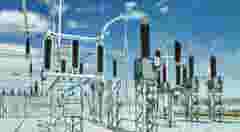
In an electric power system, switchgear is the combination of electrical disconnect switches, fuses or circuit breakers used to control, protect, and isolate electrical equipment. Switchgears are used both to de-energize equipment to allow work to be done and to clear faults downstream.
First challenge is to safely acquire the voltages and currents to be measured. Testing hundreds of thousands of volts and amperes is not a trivial task. User safety is a must, while the instrumentation needs to be able to acquire high voltage signals and low voltage current shunt signals with high fidelity, sit on high potential, and withstand huge electrical and magnetic fields.
Then, during testing a switchgear, the contacts will be opened (O), closed (C) and - depending on the test type - opened(O) again; this is called OC or OCO measurement.
The contact movement is typically controlled by using electrical signals. These signals initiate the movement of contacts in the mechanical switch for the circuit to be opened or to be closed.
For medium and low voltage switchgear measurements there is often no signal available for registering the exact position of the contacts, therefore the time between the open or close action and the measured moment of contact touch or separation will be determined in a no-load test first.
These variables then can be used for the full load (short-circuit) tests.
To enable harmonized testing in both R&D as certification processes, required analysis routines are fixed in STL routines.
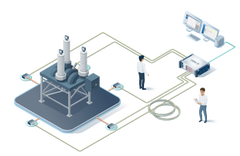 Conceptual test setup with Switchgear, Isolated Digitizer, Genesis HighSpeed mainframe and Perception software.
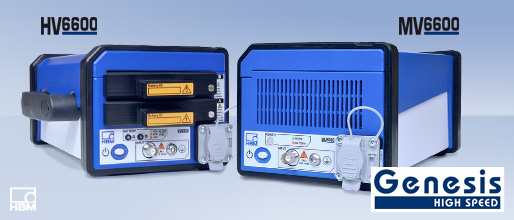
Components of a typical test system: Multiple FO isolated Digitizers 6600 close to the DuT, fiber optical cables back to the control room, and Genesis HighSpeed mainframe in the control room.
These are the most critical part of the acquisition system. Built on 30 years of experience in HV HP testing, these 3rd generation instruments feature voltage inputs spanning from low voltage shunt measurements to 200 V inputs for resistive or capacitive divider outputs.
Their intense shielding concept makes the immune against magnetic fields up to 200000 A/m guaranteeing high fidelity signal capture in this difficult environment.
Dual and hot-swap batteries ensure 16 h or continuous operation not connected to any ground. For lower isolation voltages up to 2 kV, a Medium voltage variant is available offering continuous operation via isolated power supply.
And the fiber-optical connection back to the mainframe – using cost effective standard or industry grade heavy duty cables – ensures error free transmission back to the mainframe in the control room and 100% user safety.
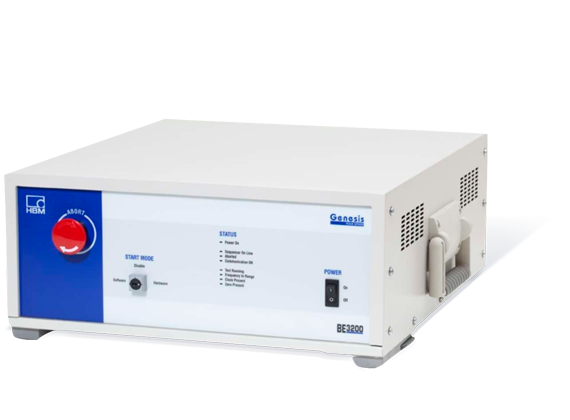
The BE3200 test sequencer is a high-speed controller providing precise timing for the operation of devices used for testing in low/high voltage and high power laboratories.
For this purpose up to 64 optically-isolated outputs are available, with extensive interlocking and safety features. The timing pattern of the BE3200 can be synchronized to the mains generator, the external mains or derived from an internal timer.
The outputs switch on and off in a programmed sequence and are fully synchronized. The synchronization signal tracks the input signal frequency. All outputs and inputs of the BE3200 are fiber optically isolated.
All of this is configurable with the dedicated Perception software section for sequencer control and linked to the switchgear testing application.
The Perception HPHV Switchgear application allows easy test setup by providing the user with an interface to identify his type of switchgear and type of test.
For the type of switchgear one has the choice of single or three phases, using travel and/or open-close signals and the applicable mains frequency required for some STL calculations.
The corresponding circuit is shown to conveniently select and connect the appropriate DAQ hardware channels and finalizing the setup by choice of required test type and equipment related variables.
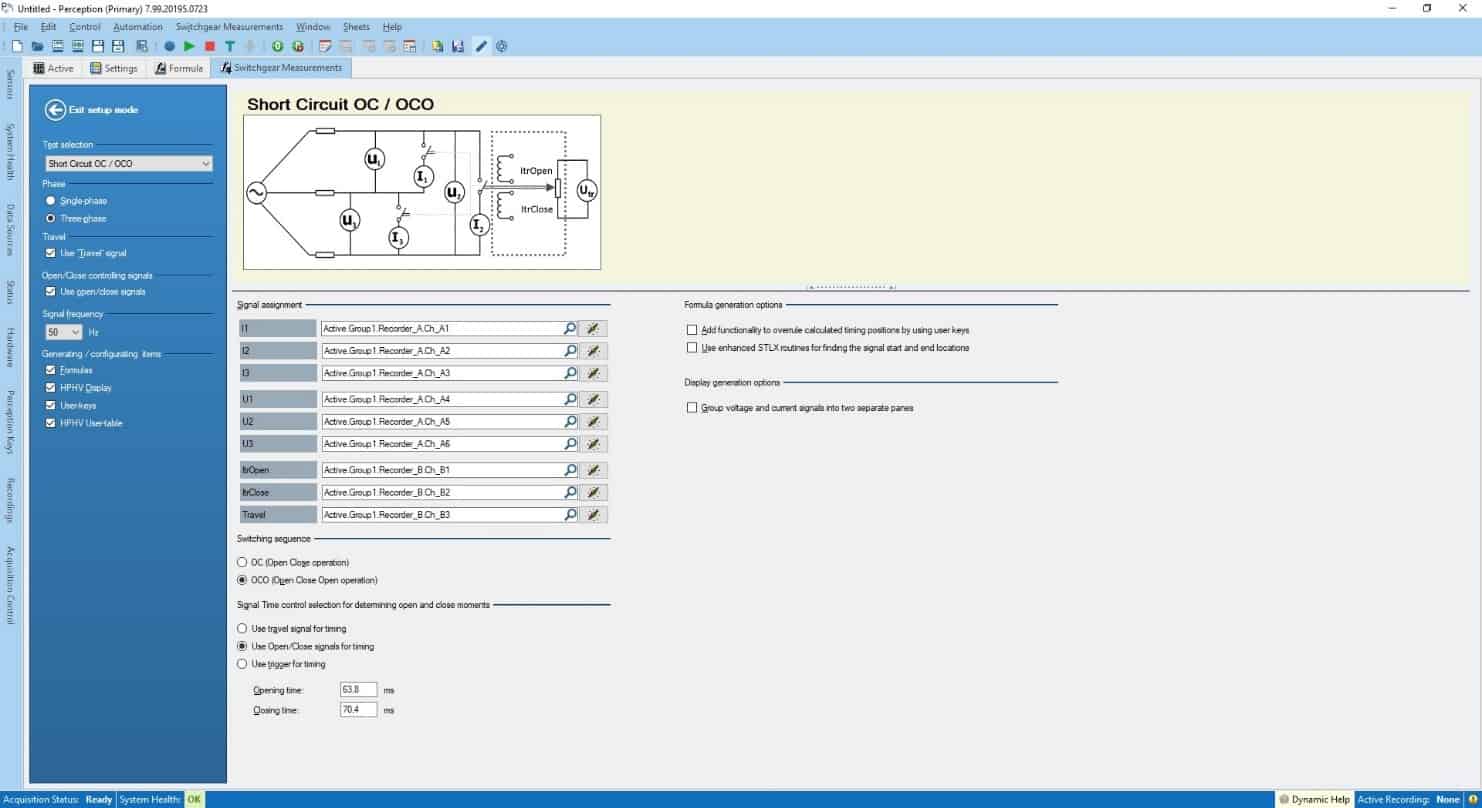
Based on selected configuration, all required formulas and equations will be written to the Perception formula database which allows the user to review any calculations used improving test transparency, troubleshooting and auditability.
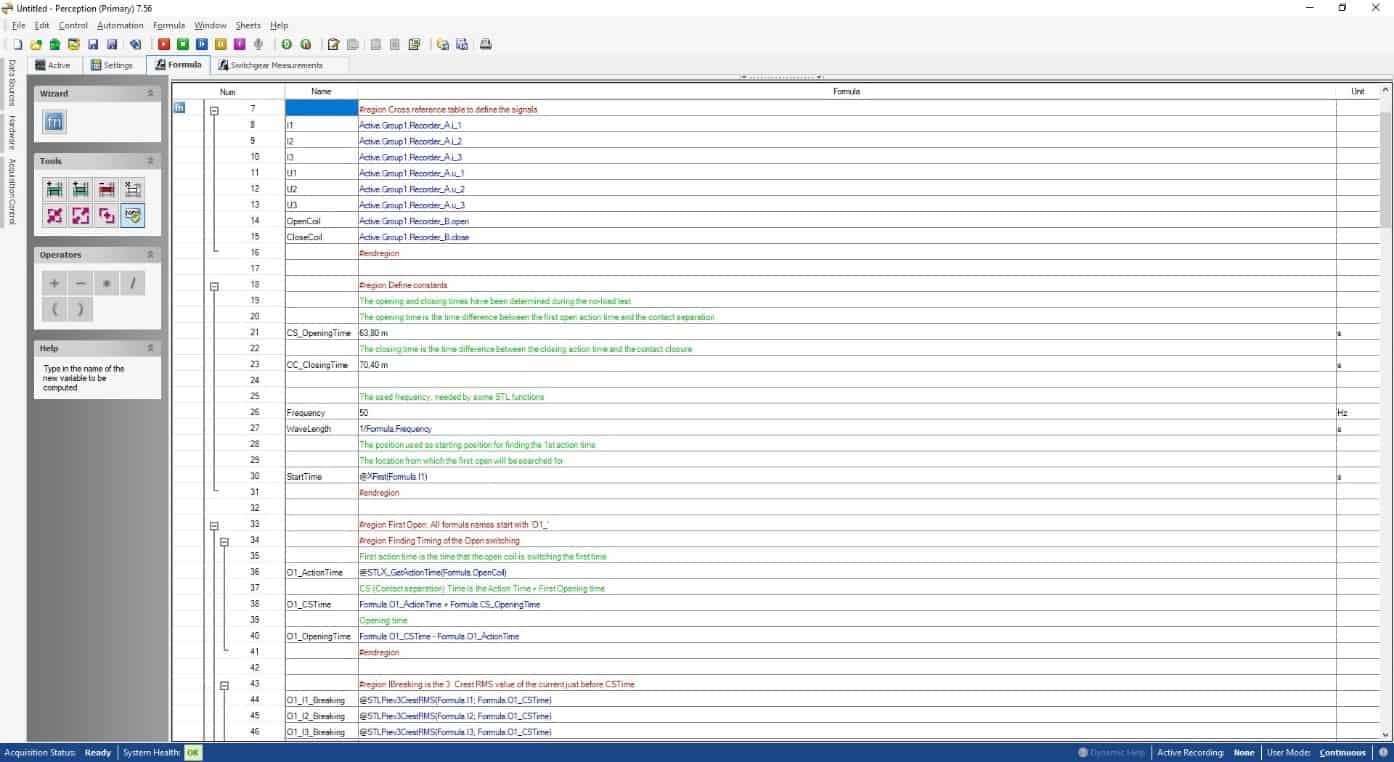
Once the test is performed, all signals are stored, and the needed results are automatically calculated.
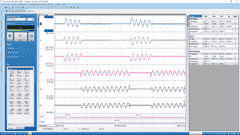
Oscilloscope displays and result tables are automatically populated with most used variables for easy reporting and can be adapted to further application or customer requirement.
This will bring together HBM, Brüel & Kjær, nCode, ReliaSoft, MicroStrain and Discom brands, helping you innovate faster for a cleaner, healthier, and more productive world.