MAIN MENU

HUMS Vibration Monitoring for Helicopters and Other Aircraft


Health and Usage Monitoring Systems (HUMS) use vibration-based condition monitoring to track critical gearbox, drivetrain, and gas turbine components in rotorcraft and select fixed-wing aircraft.

Using aerospace-grade accelerometers, HUMS enable earlier fault detection, improved safety, and data-driven maintenance that reduces unplanned downtime and costly failures.

HBK also offers AI-enabled solutions for predictive maintenance, reliability, and asset performance management.

Key Areas of Application

helicopter in a sea rescue

Rotor Track and Balance

Airborne, internally amplified HUMS and base-isolated accelerometers can be used for rotor track and balance, rotor smoothing, airframe vibration feedback and swashplate bearing wear indicators. Other common uses are in wide–band frequency aircraft/airframe vibration measurements and general-purpose HUMS applications, modal and structural analysis, as well as vibration control.

helicopter in a sea rescue

Hanger Bearing, Tail Rotor, Driveshafts

Sensors in this category measure imbalance, misalignment, and bearing wear in drive shafts and slower-rotating components. This group features the Dytran-innovated “Bracket-Style” mounting configuration that allows installation under the head of a bolt, eliminating the need for a separate mounting bracket. Measurement axis direction varies according to the intended mounting location, allowing orientation of the accelerometer to the axis of greatest motion.

helicopter in a sea rescue

Transmission, Gearbox, Bearings

This group addresses the main gearbox, accessory gearbox, intermediate and tail rotor gearbox. Users select these sensors for shaft order 1 (SO1), shaft order 2 (SO2), gear mesh frequency, gear tooth indicators, and bearing wear indicators. This group is characterized by the excellent high-frequency response to 20 kHz and ring-style mounting to accommodate cable and connector orientation.

helicopter in a sea rescue

Engine

Designed for power turbine and gas generator “hot section” locations to measure vibration spectrum during run-up and SO1, SO2 at the shaft origin between the engine and transmission. The products are configured using charge-mode (non-amplified) high-temperature accelerometers, an in-line charge amplifier, and interconnecting cables. The combined system operates from IEPE power and allows the user to measure vibration in a high-temperature location while mounting the amplifying electronics in a remote, lower-temperature environment.

helicopter in a sea rescue

CAN-MD®

A radically new sensing approach that eliminates the need for a centralized processing unit or “HUMS box.” CAN-MD® CAN-Bus based sensors contain integral DSP microprocessors to allow for all signal processing to be done within the sensor itself, eliminating the need for a centralized Data Acquisition System. CAN-MD® offers a highly expandable system with a capability of adding up to 31 sensor nodes on a single CAN-Bus.

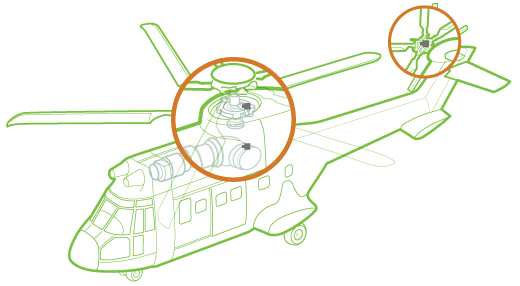
Health and usage monitoring systems (HUMS) system overview

System Suggestion

HBK supplies a range of HUMS and engine-monitoring accelerometers, whose design is focused on guaranteeing a highly robust and highly reliable sensor. Sensors must operate continuously in demanding environmental conditions yet be sensitive enough to be able to detect incipient bearing and gear failures. Size and ease of mounting are equally important considerations for these applications

Related Products

HBK solutions for vibration monitoring challenges in rotorcraft health management

chevron_left
chevron_right
OLYMPUS DIGITAL CAMERA

Challenge:

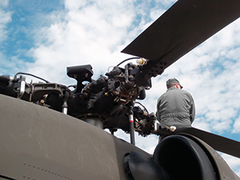
Monitoring high rotor vibration levels and maintaining rotor track and balance

Rotor systems are subject to significant vibration that can impact flight stability and accelerate wear of associated components. Accurate measurement of these vibrations is necessary to maintain rotor smoothness and detect early signs of imbalance.

Solution:

HBK’s airborne accelerometers, such as the 3062A Series, provide the wide frequency range and sensitivity required for rotor track and balance, rotor smoothing, and airframe vibration feedback. These sensors are specifically designed for airborne environments.

Result:

More stable rotor behaviour, reduced vibration levels, and improved operational safety due to earlier identification of rotor related issues.

image

Challenge:

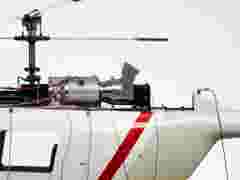
Detecting drivetrain issues such as imbalance, misalignment, and bearing wear

Driveshafts, tail rotors, and slower speed rotating components can mask subtle vibration signatures that indicate early mechanical issues. These locations often present mounting challenges and require sensors that can be oriented toward the axis of greatest motion.

Solution:

Bracket style accelerometers - including the 3077A, 3078A, 3079A, and 3232A models - mount directly under bolt heads, eliminating the need for separate brackets. These sensors provide directional flexibility, integral cable options, and rugged construction suited for drivetrain environments.

Result:

Improved detection of drivetrain wear and misalignment, leading to reduced unplanned maintenance and more reliable aircraft operation.


BK_2212 032

Challenge:

Identifying gearbox faults that require high-frequency vibration measurement

Transmission systems - including the main gearbox, accessory gearbox, and tail rotor gearbox - produce high-frequency vibration signatures such as gear mesh frequencies and shaft order harmonics. Capturing these indicators demands sensors with excellent high-frequency response and stable mounting geometry.

Solution:

High-frequency airborne accelerometers, such as the 3168F and 3168D2 models, offer frequency response capabilities up to 20 kHz and use ring style mounting to accommodate cable and connector orientation while maintaining measurement integrity.

Result:

More accurate detection of gearbox anomalies and early recognition of mechanical degradation, supporting safer and more efficient maintenance planning.

Orange self-driving passenger drone takeoff from helipad

Challenge:

Sensors with complex cabling could be difficult to deploy quickly and cost-effectively

Solution:

Wireless sensor networks complement traditional HUMS sensors by providing flexibility and simple scalability. They’re time-synchronised, lightweight and easy to install into tight spaces where cabling isn’t an option. Wireless nodes support short-term or recurring projects for troubleshooting and validation, as well as longer-duration monitoring programmes where added context (structural loads, environmental conditions, or localised response) helps interpret HUMS alerts and improve maintenance decisions.

Result:

Expanded HUMS coverage with less installation effort and aircraft downtime, faster investigation of recurring alerts, and improved confidence in maintenance prioritisation through correlated, multi-parameter context.


FAQ

They measure vibration across rotor, drivetrain, gearbox, engine, and airframe components, providing the indicators needed by HUMS to detect imbalance, wear, and structural issues.

Yes. They are specifically developed for tough airborne conditions and have been field proven on both military and civilian rotorcraft since the late 1980s. 

Yes. Certain airborne accelerometer models provide high frequency response up to 20 kHz, allowing measurement of gear mesh frequencies and shaft order harmonics. 

Yes. Bracket style sensors are available for mounting under bolt heads and can be oriented to align with the axis of greatest drivetrain motion. 

HUMS enables condition-based and predictive maintenance by continuously monitoring vibration and usage data, allowing operators to detect faults early and reduce unnecessary maintenance actions.

Yes. HUMS data can be aggregated and analysed across fleets to identify trends, improve reliability, and optimize maintenance planning at scale.

HUMS supports both real-time monitoring and post-flight diagnostics, enabling immediate alerts as well as deeper analysis after operation.

Smart sensors perform onboard signal processing and data reduction, enabling more efficient data transmission, faster diagnostics, and reduced system load.

Wireless sensing is well suited for situations where cabling is cost-prohibitive, impractical, or too heavy. Wireless sensors are also used for supplemental monitoring when you need additional coverage without modifying the existing HUMS installation. It can help investigate recurring alerts, add context near suspected problem areas, and support quicker “confirm and act” maintenance decisions.

Yes. Wireless sensor networks can capture time-synchronised measurements across multiple nodes, enabling correlation of structural response and operating conditions during events of interest (configuration dependent).

Depending on node and sensor configuration, wireless measurements can include acceleration, strain, temperature, and other condition/usage parameters that support condition-based monitoring and help interpret vibration trends alongside traditional HUMS sensors.