Sensors
The Smart sensor portfolio is an example of very unique capabilities of internal processor of signals to output a analized response.
Read More

The Smart sensor portfolio is an example of very unique capabilities of internal processor of signals to output a analized response.

the Adapters catalog is allowing the using multiple interconnects within the measurement chain.

Cables for smart sensors are specific for the application. HBK Dytran is able to customized the cables requirements for any application.

Accessories are optional tools for the proper installation and utilization of our smart sensors.
Modern machines generate massive volumes of vibration data that are difficult to manage, especially in distributed or embedded systems.
Smart accelerometers solve this by processing vibration signals directly at the sensor and delivering real-time diagnostic insights instead of raw waveform data.
Actionable insights. Faster decisions. Simpler systems.
In this video, Brian Johnson, Applications Development Supervisor at Dytran by HBK, introduces CAN‑MD smart sensor technology. He outlines the background and capabilities of CAN‑MD, explains key applications and benefits, and provides an overview of the available developer kits, software and product line developments.
Watch the video to see how CAN‑MD enables a smarter approach to machine health monitoring.
Traditional vibration monitoring relies on raw data collection and centralised processing, which creates major limitations:
Result: more data, but less insight
Smart accelerometers embed signal processing and diagnostics directly inside each sensor, transforming vibration monitoring into a real-time decision system.
How it works:
No raw data streaming. Only actionable insights
Smart accelerometers operate as independent nodes on a CAN network, enabling efficient distributed monitoring:
Built for industrial and embedded applications
Smart accelerometers are built on the CAN‑MD architecture — a distributed sensing platform where each sensor acts as an intelligent node performing acquisition, signal processing, and condition indicator extraction locally.
This approach enables deterministic CAN communication, reduced data bandwidth, and advanced diagnostics at the edge.
Choosing the right accelerometer architecture depends on how vibration data will be used.
| Feature | Traditional Analog Accelerometer + DAQSmart Accelerometer | Smart Accelerometer |
| Signal output | Continuous analog waveform | Processed digital condition indicators |
| Signal processing | External DAQ and software | Embedded inside sensor |
| Wiring | Point-to-point | Single CAN Bus Wire – Up to 30 sensors per |
| Installation complexity | Higher | Simplified |
| Data bandwidth | High | Controlled and predictable |
| Scalability | Moderate | High - Ability to include Traditional Sensing Technologies into CAN Structure |
| Best suited for | detailed waveform analysis, lab testing, R&D | distributed monitoring, predictive maintenance, embedded diagnostics |

CAN‑MD smart sensors combine vibration sensing, signal processing and CAN bus communication in a single device. By delivering actionable condition data directly at the sensor, they reduce system complexity and support more efficient, reliable machine health monitoring.
Download our white paper to explore the technology and learn how to build a smarter condition-based maintenance strategy.
Smart accelerometers are especially valuable where data efficiency, reduced wiring, distributed diagnostics, and reliability are essential.
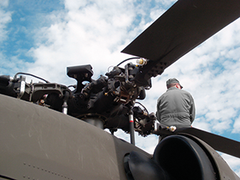
Smart accelerometers support distributed vibration monitoring in rotorcraft HUMS, propulsion systems, and airborne structures.
Embedded processing at sensor level reduces wiring weight and transmits relevant condition indicators over onboard networks.
This architecture improves fault detection on rotating components while supporting platform reliability and lifecycle management.
Monitor vibration signatures across motors, servo drives, robotic gearboxes, and spindles with real-time diagnostic intelligence.
Smart accelerometers process critical condition indicators locally and transmit only essential data, helping maintenance teams detect imbalance, bearing degradation, or mechanical looseness without saturating industrial communication networks.

Enable continuous condition monitoring of bogies, wheelsets, axle boxes, traction systems, and auxiliary equipment across rolling stock fleets.
Smart accelerometers provide stable vibration data over distributed networks, supporting earlier fault detection, improved asset availability, and more efficient condition-based maintenance strategies.

Integrated directly into CAN-based vehicle architectures, smart accelerometers monitor drivetrain vibration, e-axles, pumps, suspension systems, and onboard auxiliary equipment.
Local signal processing improves diagnostic efficiency while reducing network load—supporting vehicle reliability, predictive maintenance, and fleet telematics.

Monitor nacelles, gearboxes, generator bearings, and pitch systems with embedded vibration diagnostics at source.
Smart accelerometers help maintenance teams detect developing faults earlier, reduce service interventions, and improve uptime across remote or difficult-to-access energy assets.

Simplify instrumentation for endurance testing, durability rigs, and accelerated validation programs.
By calculating condition indicators directly inside the sensor, smart accelerometers reduce data acquisition requirements while providing real-time vibration insight throughout long-duration test campaigns.

The Réseau express métropolitain (REM) is the world’s longest automated light rail network, serving the Greater Montréal area. To meet strict safety requirements in tunnels and stations, REM needed a reliable way to monitor smoke evacuation fans. This case study shows how CAN‑MD smart sensors enable proactive vibration monitoring to improve safety, reliability and operational efficiency.

HBK offers smart accelerometer solutions designed for demanding vibration monitoring applications. Our portfolio supports distributed diagnostics across aerospace, transportation, industrial automation, and mobile platforms.
A smart accelerometer combines vibration sensing, signal conditioning, embedded processing, and digital communication inside a single sensor. Instead of delivering only raw vibration signals, it provides processed condition indicators directly from the sensor.
By processing vibration data locally. Only relevant outputs such as RMS, FFT-based indicators, peak values, or configured health metrics are transmitted, reducing network traffic and storage requirements.
Choose smart accelerometers when you need:
Traditional analog accelerometers remain ideal for deep waveform analysis and lab-based testing.
Yes. Many smart accelerometers are designed for CAN-based communication, allowing multiple sensors to operate over one network while simplifying installation and improving scalability.
Yes. They are widely used in aerospace, transportation, industrial machinery, and mobile platforms where vibration, shock, temperature variation, and reliability are critical.

This will bring together HBM, Brüel & Kjær, nCode, ReliaSoft, MicroStrain and Discom brands, helping you innovate faster for a cleaner, healthier, and more productive world.