arrow_back_ios

Main Menu

arrow_back_ios

Main Menu

arrow_back_ios

Main Menu

Introduction of fatigue analysis of joints

Fatigue analysis of joints must account for the distinct configurations used in engineering applications, as each type exhibits different stress distributions and failure modes. Seam welds, for example, are continuous welded connections that are typically subjected to membrane and bending stresses. Adhesives, spot welds and rivets, are more susceptible to shear and peel stresses.

The methodology for fatigue analysis combines experimental testing with numerical modelling to develop a comprehensive understanding of joint performance. Bespoke testing is first carried out for each joint type under representative loading conditions. Seam welds are tested with “stiff” and “flexible” geometries to test their performance under nearly pure membrane and bending stresses. While adhesives, spot welds, and rivets are tested under lap shear and coach peel configurations. The tests are performed under load-controlled cyclic loading, and their performance is tracked through measurements such as stiffness drop, which indicates crack initiation and propagation. From these experiments, load-life data is obtained, describing the relationship between applied loads and the number of cycles to failure.

To translate these results into design-relevant information, reverse engineering techniques are applied using finite element analysis (FEA). This enables stresses to be back-calculated from the experimental load-life data and used to construct stress-life (S–N) relationships for each joint type. By integrating experimental results with computational modelling, this approach provides realistic fatigue life predictions and ensures reliable assessment of joint durability.
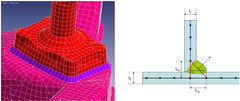
AMCT weld finite element model
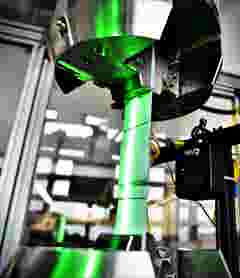
AMCT lap shear rivet test

Specimen image courtesy of NIO Performance Engineering Limited

Key Benefits of testing joints

  • Provides key properties of the joints: 
    • Load-life curves
    • Stress-life curves for use in nCode DesignLife
  • Improve product durability and reliability.

Testing Capabilities

Type of joints

  •  Seam welds
  •  Spot welds
  •  Rivets
  •  Adhesives 
  • Hybrid joints: We offer comprehensive analysis of joints using adhesives combined with rivets or spot welds to accurately estimate their enhanced fatigue performance.
  • Bespoke testing: We offer customised testing configuration to accommodate non-standard type of joints.

Loading configuration:

  • Uni-axial
  • Three- or four-point bending
  • Bespoke
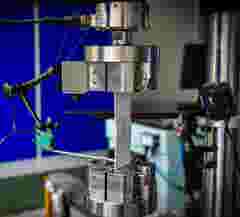
AMCT coach peel adhesive test

Test to Standards

  • ASTM E466-21 Standard Practice for Conducting Force Controlled Constant Amplitude Axial Fatigue Tests of Metallic Materials
  • BS 3518:1993 Methods of fatigue testing. Methods of fatigue testing. Guide to general principles
  • ISO 1099:2017 Metallic materials - Fatigue testing - Axial force-controlled method
  • BS EN ISO 14273:2016 Resistance welding — Destructive testing of welds — Specimen dimensions and procedure for tensile shear testing resistance spot and embossed projection welds
  • BS EN ISO 14270:2016 Resistance welding — Destructive testing of welds — Specimen dimensions and procedure for mechanized peel testing resistance spot, seam and embossed projection welds
  • BS EN ISO 18592:2019  Resistance welding – Destructive testing of welds – Method for the fatigue testing of multi-spot-welded specimens
  • BS EN ISO 14324:2003 Resistance spot welding – Destructive testing of welds – Method for the fatigue testing of spot-welded joints
  • ASTM D1002-10R19 Standard Test Method for Apparent Shear Strength of Single-Lap-Joint Adhesively Bonded Metal Specimens by Tension Loading (Metal-to-Metal)
  • ASTM D1876-08R23 Standard Test Method for Peel Resistance of Adhesives (T-Peel Test) 
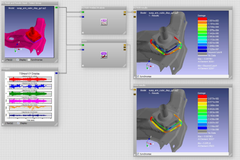
AMCT weld analysis workflow

Results for CAE

  • Reassured with analysed data - We cover comprehensive data analysis of the testing results.
  • Results for CAE - We provide parameters that are ready-to-use in nCode DesignLife.
  • Confidence & Reliability – Data imported in nCode DesignLife provides design curves for product optimisation.

Technical Papers

  1. Halfpenny, A. and Vervoort, S. (2024) ‘Dynamic Fatigue Analysis of a Welded Joint Under Sequential and Simultaneous Multiaxial Random PSD Loading’, VAL5 Fifth International Conference on Material and Component Performance Under Variable Amplitude Loading, DVM Materials Research and Testing e.V., Dresden, Germany.
  2. Bagni, C., Halfpenny, A., Hill, M. and Tarasek, A. (2024) ‘A pragmatic approach for the fatigue life estimation of hybrid joints’, Procedia Structural Integrity, 57, pp. 859-871.
  3. Bagni, C., Halfpenny, A., Hill, M. and Tarasek, A. (2024) ‘A practical methodology for the fatigue life estimation of adhesive joints’, Procedia Structural Integrity, 57, pp. 598-610.
  4. Bagni, C., Halfpenny, A., Hill, M. and Tarasek, A. (2024) ‘A practical approach for the fatigue life estimation of hybrid joints through testing and numerical simulations’, in: Cawte, E. R. , Cockings, H. L., Stekovic, S. and Yates, J. R. (Eds.), Proceedings of the 9th Engineering Integrity Society International Conference on Durability & Fatigue, 1, pp. 44-57. 19-21 June 2024, Jesus College, Cambridge, United Kingdom.
  5. Bagni, C., Tarasek, A., Halfpenny, A. and Hill, M. (2025) ‘Predicting The Fatigue Life Of Adhesive And Hybrid Joints: An Effective Approach Combining Numerical Simulations And Physical Testing’, NAFEMS World Congress 2025, Salzburg, Austria. [Online]. Available: https://www.nafems.org/publications/resource_center/nwc25-0006998-paper/
  6. Halfpenny, A., Plaskitt, R., Mantley, J. and Mann, N. (2012) ‘Fatigue Analysis of a Pressure Vessel Welded Joint Using the Stress Integration Method Outlined in the ASME Boiler & Pressure Vessel Code VIII’, 12th International Conference on Engineering Structural Integrity Assessment, EMAS Publishing.

Recommended for You