Stress-life fatigue testing, also known as S-N testing (Stress vs. Number of cycles), is a fundamental method used to evaluate the fatigue behaviour of materials under cyclic loading. This type of testing is essential for understanding how materials respond to repeated stress applications, especially when the stress levels are below the material’s yield strength.
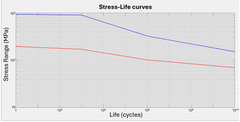
The primary goal of stress-life testing is to generate an S-N curve, which represents the relationship between the cyclic stress range and the number of cycles to failure. By subjecting specimens to a constant amplitude cyclic load until failure, engineers can determine the material’s fatigue life. This data is critical for the safe and reliable design of components in industries such as aerospace, automotive, and structural engineering, where materials are routinely exposed to fluctuating stresses.
Stress-life testing is most applicable to materials/components that operate in the high-cycle fatigue regime, where material exhibit fully elastic behaviour. It is used to determine the fatigue limit—a stress level below which the material can theoretically endure infinite cycles without failure. The results provide valuable insight into the durability and long-term performance of materials under realistic service conditions.
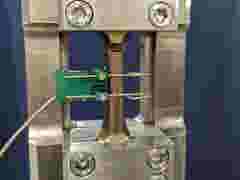
Strain-life fatigue testing, often referred to as E-N testing (strain vs. number of cycles), is a fatigue analysis method used to characterise the behaviour of materials under high strain or low-cycle fatigue conditions. Unlike stress-life (S-N) testing, which is more applicable to high-cycle fatigue with lower stress levels, strain-life testing focuses on situations where materials experience plastic deformation during each load cycle.
In this method, a specimen is subjected to controlled, repeated strain cycles, and the number of cycles to failure is recorded. The resulting data is used to develop an ε-N curve, which describes how a material’s fatigue life relates to the imposed strain amplitude. This approach accounts for both the elastic and plastic components of strain, making it particularly valuable for analysing components that undergo large stress reversals, such as in turbine engines, automotive suspensions, and pressure vessels.
Strain-life testing is crucial for accurate fatigue life predictions in applications where materials are pushed near or beyond their yield strength. It provides insights into crack initiation behaviour—a key phase in fatigue failure—making it a vital tool for engineers designing components for demanding mechanical environments.
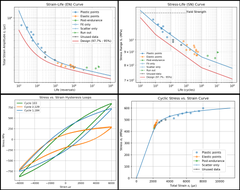
o Strain-life curve & stress-life curve
o Cyclic stress-strain curve
o Cyclic strength coefficient and hardening exponent (K' & n')
o Elastic modulus and yield strength (E & σγ)
o Fatigue strength coefficient and exponent (σ'f & b)
o Fatigue ductility coefficient & exponent (ε'f & c)
o Endurance limit
*All capabilities are subjected to specimen geometry and material
Tests are performed to international, internal or bespoke standards.
Stress-life testing
Strain-life testing
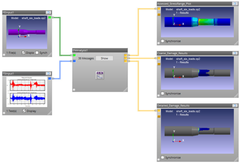

HBK’s AMCT is an established fatigue testing facility with over 25 years of operational experience and ISO 9001:2015 certification.

This will bring together HBM, Brüel & Kjær, nCode, ReliaSoft, MicroStrain and Discom brands, helping you innovate faster for a cleaner, healthier, and more productive world.