

Filling, Dosing and Checkweighing Control
Read More

Networking machines, sensors, and other systems efficiently, securely, and scalably can be a complex business.
Choosing the right communication protocol might seem like a small thing at first, but it’s easy to get lost when choosing between MQTT, REST, and OPC UA.
In this article, we’ll explore the most common communication protocols, from how they work to where they thrive and their biggest limitations.
So it’s easy for you to find the right standard – and ensure your application works as smoothly, efficiently, and reliably as possible.
Here’s a quick summary of the communication protocols and which applications they’re most suitable for.
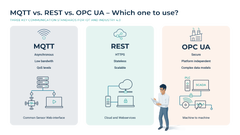
Of course, these communication standards don’t work completely independently. They are often combined with one another, allowing the strengths of one protocol to balance out the challenges of another.
For example, you’ll often see ‘OPC UA over MQTT’, where OPC UA data is transmitted in the form of MQTT messages in order to improve security while saving bandwidth.
Choosing the right communication standard can be confusing at first. But finding the right protocol really comes down to understanding the unique characteristics of MQTT, REST, and OPC UA – and matching those characteristics to your application.
A lightweight network protocol for IoT communication.
MQTT is based on a public-subscribe model, meaning that devices and applications (or ‘MQTT clients’) publish data on ‘topics’ to a central broker.
Other applications or clients can subscribe to these topics via to broker in order to receive the associated messages.
MQTT is perfect for smaller IoT devices and platforms.
It’s also a powerful protocol for use in sensor networks.
As a result, it’s often used as a communication protocol in predictive maintenance contexts. That’s why MQTT plays a crucial role in our digiBOX amplifier; by using MQTT in combination with openDAQ, we’ve made it easy to integrate the digiBOX with a wide range of cloud applications and analytics processes.
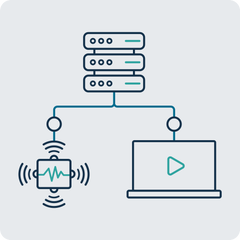
The scenario: An automotive manufacturer wants to record sensor data from its machines in real time, so that it can detect anomalies earlier.
MQTT’s publish-subscribe principle makes it the ideal communication protocol.
The sensors continuously send data to a central MQTT broker, which distributes it to the relevant systems. Engineers use this data to monitor both machine performance and environmental parameters, allowing them to optimise every aspect of the machine’s operations.
Crucially, the data moves fast and reliably. As a result, engineers can move fast to fix issues – and have peace of mind that they’re never missing a red flag or a chance to optimise their products.
An architectural style, based on HTTP requests, for web interfaces.
When using REST, a server provides resources via a web interface – the REST API.
Client applications then address a resource using a unique address. The applications then use HTTP methods like GET, POST, PUT, or DELETE to retrieve, create, change, or delete data.
Since REST is based on commonly used internet technology, it’s much easier to use and integrate into existing infrastructures than other protocols.
As a result, REST APIs are used by a wide variety of web services, web applications, and cloud platforms.
However, you can also use REST APIs to communicate with industrial devices – as you’ll see below.
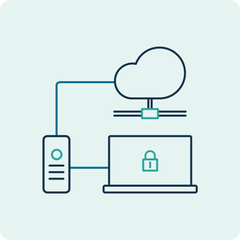
The scenario: A manufacturer of sensors for industrial equipment is looking for a way to transfer sensor data from a production hall to a central cloud platform.
In this situation, REST APIs make standardised HTTP communication between the machines and the cloud simple. They’re also easy to integrate with existing MES and ERP systems, allowing the manufacturer to get up and running quickly and with minimal disruption.
And, if the manufacturer’s production scales up, REST ensures that the manufacturer’s analysis and optimisation processes can scale with it.
An industrial communication standard for data exchangebetween automation devices and software systems. It has established itself as one of the most important standards in industrial automation, spanning industries and applications.
Machines and devices from different manufacturers can use OPC UA to provide data in a standardised format, or receive it for control purposes.
To work, OPC UA requires an OPC UA server that can ‘translate’ between proprietary interfaces and the OPC UA standard.
Software applications like MES or ERP systems use OPC UA clients to retrieve data and transmit it to controllers.
OPC UA is used in our ClipX one-channel signal conditioner, allowing it to connect industrial equipment into one cohesive, communicative system – all built around seamless data collection.
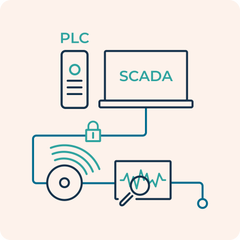
The scenario: A manufacturing company wants seamless communication between the PLC and SCADA control systems in its production hall.
OPC UA’s ability to standardise the transfer of machine data makes it the perfect match for this application. It’s also able to map complex data models ensuring that the right information reaches the right place every time, no matter how complex the manufacturer’s ecosystem becomes. Thanks to OPC UA’s integrated security layer, the manufacturer knows that its data is safe from cybercriminals, too.
There’s no one-size-fits-all when it comes to communication protocols.
MQTT offers lightweight efficiency for IoT networks, REST delivers simplicity and scalability for web-based infrastructures, and OPC UA brings robust, secure data exchange for industrial environments.
Sometimes, the smartest approach is a hybrid one – layering protocols to combine their strengths and balance out their weaknesses.
Whether you’re connecting machines, sensors, or cloud systems, understanding the protocols behind them helps you build smarter, faster, and more secure systems.




Robust Strain Gauge and Charge Amplifier with IT/OT Connectivity
The new and precise multi-channel strain gauge and charge amplifier impresses with modern automation and cloud interfaces, an intuitive web server and integrated measurement data preprocessing in real time (incl. calibration-certificate).

This will bring together HBM, Brüel & Kjær, nCode, ReliaSoft, MicroStrain and Discom brands, helping you innovate faster for a cleaner, healthier, and more productive world.
