Uneven terrain, shifting payloads, changing contacts and external forces challenge robot stability. Reliable balance and dynamic control depend on understanding both how the robot moves and how mechanical loads are distributed.
For humanoids, quadrupeds and mobile manipulators, balance, locomotion and manipulation increasingly rely on coordinated whole-body control. The effectiveness of that control depends on accurate estimates of body motion, support conditions and physical interaction.
HBK combines inertial and mechanical measurement technologies to provide complementary insights into these physical states. Embedded AHRS modules, multi-axis force/torque sensors and application-specific joint-torque and load sensing solutions help OEMs measure motion, contact forces and load distribution. Together with encoders, vision and robot models, these measurements provide valuable inputs for state estimation and dynamic control.
Explore how inertial, six-axis force/torque and joint-torque sensing work together to make body motion, contact forces, load transfer and actuator loads measurable for humanoid balance, locomotion, interaction and control.
Learn how sensor placement, synchronisation and integration turn these physical measurements into reliable inputs for real-time state estimation and whole-body control.
Robot stability depends on how accurately the control architecture represents changing motion, support conditions and external interactions. Different operating conditions introduce different measurement requirements.
| Engineering challenge | Measurement approach |
| Robot motion changes continuously. Acceleration, rotation and posture transitions challenge state estimation. | Measure body motion. IMUs measure acceleration and angular rate, while AHRS sensor fusion estimates orientation for use in the OEM’s estimation and control architecture. |
| Support conditions vary. Foot contacts, payload movement and posture changes redistribute loads. | Measure loads along the paths that matter. Force and torque sensors capture support loads directly, giving the estimator measured inputs for load distribution and centre-of-mass shifts rather than relying on nominal payload assumptions. |
| External interaction introduces disturbances. Pushes, impacts and manipulation can alter stability. | Measure interface forces and moments. Multi-axis force/torque sensing characterises contact at feet, ankles, wrists and end effectors, while joint-torque sensing captures loading within the actuation chain. |
| Sensor streams can differ in timing. Misalignment, delay and calibration errors reduce their usefulness in feedback loops. | Design timing and integration together. Evaluate sampling, synchronisation, end-to-end latency, calibration and interfaces alongside accuracy. |
| Operating conditions vary. Uneven ground, changes in friction and variable payloads challenge fixed model assumptions. | Measure what fixed models miss. Motion and contact data give terrain-adaptation and disturbance-response algorithms real feedback when conditions differ from model assumptions. |
Sensor selection depends on the mechanical load path and control objective. An ankle sensor can characterise foot-ground loading, a wrist sensor can measure manipulation forces, and a joint-torque sensor can provide direct feedback on actuator output loading.
Many robots estimate joint torque and contact forces using motor current and dynamic models. These approaches can be effective, but unmodelled friction, backlash and rapid transients can affect estimation accuracy. Direct force and torque sensing provides independent measurements at selected mechanical interfaces. Combining measured and estimated data can improve the physical inputs available for contact estimation and balance control.
An IMU measures linear acceleration and angular rate, while an AHRS combines inertial measurements with sensor fusion to estimate orientation. These measurements provide essential information about body motion during locomotion, posture transitions and external disturbances.
For robotics OEMs, sensor placement, alignment and timing are critical to obtaining reliable motion data.
HBK MicroStrain inertial sensing solutions are designed for integration into robotic systems, providing motion and orientation inputs for state estimation and dynamic balance control.
Robot stability depends not only on motion but also on how mechanical loads are distributed throughout the structure and its support points. Force-, torque- and strain-based sensors integrated into feet, ankles, joints or other load paths provide direct measurements of loading during movement, contact transitions and payload changes.
Joint-torque sensing also provides feedback on actuator output loading, complementing estimates derived from motor current and dynamic models.
HBK supports OEMs with application-specific sensing solutions designed around mechanical integration, measurement range and load-path requirements.
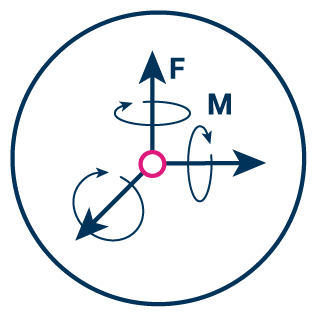
Physical interaction introduces forces and moments that can affect robot stability, particularly during walking, manipulation and unexpected contact. Six-axis force/torque sensors measure three force components (Fx, Fy, Fz) and three moment components (Mx, My, Mz) at a selected interface.
Integrated into feet, ankles, wrists or end effectors, these sensors help engineers characterise contact loading, external disturbances and interaction forces.
HBK multi-axis OEM sensing solutions provide mechanical feedback that can complement inertial measurements and support contact estimation and dynamic control.
Reliable robot state estimation requires complementary information about body motion, mechanical loading and contact conditions. The OEM’s estimation architecture combines time-aligned inertial, force and torque measurements with joint encoderdata, robot models and other available sensor inputs.
This information supports estimates of body state, load distribution and contact conditions, enabling the controller to calculate appropriate responses as operating conditions change.
HBK contributes the physical measurement layer, with OEM sensing solutions designed to meet application requirements for accuracy, sampling, synchronisation and integration.
Every actuator adjustment changes the robot’s physical state, generating new motion, loading and contact conditions. Continuous inertial and mechanical measurements provide updated information to the robot’s estimation and control architecture, closing the loop between physical behaviour, measurement, estimation and response.
For dynamic locomotion, manipulation and whole-body control, measurement quality, timing and integration are essential for providing usable feedback within the control cycle.
HBK works with robotics OEMs to develop sensing solutions tailored to mechanical constraints, measurement requirements and system interfaces.
The controller coordinates balance, locomotion and manipulation within the robot’s contact, actuator and dynamic constraints.
IMUs measure acceleration and angular rate, while AHRS sensor fusion estimates orientation. Encoders measure joint position, while force, torque and load sensors characterise mechanical loading. The combination depends on the robot architecture and control requirements.
Inertial data supports estimation of body motion during dynamic operation. Orientation is estimated through sensor fusion, and performance depends on sensor quality, operating conditions and integration.
Inertial data describes how the robot moves, while force and torque data describes how it is loaded at the measured interfaces. Together they help the estimator separate motion from support and contact conditions.
They measure loading at support, joint and manipulation interfaces. This provides measured inputs for contact estimation and balance control, including during impacts and fast transients, when model-based estimates can be affected by unmodelled transmission behaviour.
Payload and posture changes can shift the centre of mass and redistribute support loads. Measuring these loads gives engineers data on the robot's actual loading rather than relying only on nominal payload assumptions.
Measurements must arrive in time for the control cycle and have consistent timestamps. Engineers should assess acquisition, communication and processing delays, and validate synchronisation across all selected sensors.
Place IMUs where they can observe the relevant body motion and install force/torque sensors along the load paths of interest, such as the feet, ankles, joints or wrists. Consider alignment, mechanical integration and calibration together.
Define the states and contacts to be estimated, then evaluate measurement range, accuracy, bandwidth, sampling, timing, calibration, mechanical fit and environmental requirements. Validate the architecture under representative motion and loading.
Ground reaction forces are the forces exchanged between the robot and the ground. Six-axis sensors at the feet or ankles show how load transfers between contacts and, together with the known foot geometry, where the centre of pressure sits relative to the support area, a key input for balance control in legged and humanoid robots.
Motor-current estimates are useful but depend on friction, backlash and dynamic models, and can be affected by unmodelled transmission behaviour and fast transients. Direct force/torque sensing provides an independent measurement at the interfaces that matter most for balance, such as the feet, ankles and wrists, and can also be used to validate model-based estimates.

This will bring together HBM, Brüel & Kjær, nCode, ReliaSoft, MicroStrain and Discom brands, helping you innovate faster for a cleaner, healthier, and more productive world.