


Tactical-grade embeddable IMU and AHRS with quad-redundant IMU architecture, integrated magnetometer, next-generation vibration rejection, and absolute magnetic heading for UAVs and legged robotics.

3DM-CX7-AHRS
The 3DM-CX7-AHRS is a tactical-grade embeddable attitude and heading reference system (AHRS) from MicroStrain by HBK. It delivers high-accuracy roll, pitch, and absolute magnetic heading by combining a quad-redundant IMU architecture with an integrated three-axis magnetometer and MicroStrain's auto-adaptive Extended Kalman Filter.
With four internal IMUs continuously monitored in parallel, the CX7-AHRS automatically detects untrustworthy measurements from any individual IMU and deweights or excludes its readings in real time. This built-in redundancy provides a level of measurement integrity not available in single-IMU designs, and is particularly valuable in high-shock and high-vibration environments where transient sensor anomalies are most likely to occur. Validated at up to 100x better attitude stability under repeated high-g shock conditions compared to the previous generation, the CX7-AHRS maintains reliable orientation where conventional sensors degrade or fail.
Key specifications include an extended ±32 g accelerometer range, ±4,000°/s gyroscope range, adjustable output rates up to 1 kHz, and a compact 8.3 g OEM form factor measuring 38 mm x 24 mm. Every unit is individually calibrated across the full -40°C to 85°C operating range. The 3DM-CX7-AHRS is NDAA compliant, ITAR free, ROS ready, and PX4 compatible. It is part of the MicroStrain C-Series inertial sensor family, backed by 80+ years of HBK measurement heritage.
| Document | Type | Language |
|---|---|---|
| 3DM-CX7-AHRS - Data Sheet | Data Sheets | English |
| 3DM-CX7-AR and 3DM-CX7-AHRS User Manual (Online) | User Manual | English |
Certificates and Approvals
| Document | Type | Language |
|---|---|---|
| 3DM-CV7 Declaration of Conformity (UK) | Declaration of Conformity | English |
| 3DM-CV7 Declaration of Conformity (EU) | Declaration of Conformity | English |
| Property | Value |
|---|---|
| Type | Attitude & Heading (AHRS) |
| Performance Grade | Tactical Grade |
| Features | Accelerometer, Barometer, Gyroscope, Magnetometer |
| Random Walk | Accel: 36 µg/√Hz, Gyro: 0.058º/√h |
| Communication Port Type | Samtec FTS-105 (2x5) |
| Communication Interface | TTL serial |
| Update Rate | 1 to 1000 Hz |
| Inputs/Outputs | 4xGPIO |
| Weight | 8.3 g |
| Weight | 0.29 oz |
| Size | 38 x 24 x 8.6 |
| Size | 1.5 x 0.94 x 0.34 |
| Power Consumption | 0.324 W |
| Input Voltage | 3.2 to 5.2 VDC |
| Minimum Operating Temperature | -40 °C |
| Maximum Operating Temperature | 85 °C |
| Minimum Operating Temperature | -40 °F |
| Maximum Operating Temperature | 185 °F |
| MTBF | 1953356 h |
| Sensing Range (Accelerometer) | 32 g |
| Sensing Range (Gyroscope) | 4000 °/s |
| Sensing Range (Magnetometer) | 8 Gauss |
| Sensing Range (Pressure) | 1260 mbar |
| Ingress Protection Rating | Not Rated |
| Housing Material | Aluminum |
| Software | InertialConnect, MSCL, ROS, SensorConnect |
| Mounting Style | Embeddable, Precision Alignment, Screw Down |
| Product Code | Description |
|---|---|
 6212-3006
|
OEM CABLE KIT |
 6212-3009
|
C-Series Development Kit, USB |
 6212-3010
|
C-Series Development Kit, RS232 |

Shock & Vibration Hardened
Up to 100x Better Shock and Vibration Robustness

NDAA Compliant, ITAR Free
Designed for global defense and aerospace programs

Trusted Navigation Data
Redundant Multi-IMU Architecture

High-Dynamic Performance
Wide Accelerometer and Gyroscope Ranges

Access your sensor's comprehensive online user manual. Find detailed setup instructions, calibration procedures, troubleshooting guides, and technical specifications all in one convenient location.
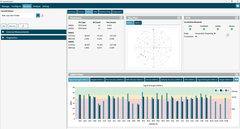
InertialConnect is the latest software solution for MicroStrain inertial sensors. With InertialConnect, you can easily configure your sensors, adjust parameters, upgrade firmware, and deploy preconfigured parameter files. You can also verify sensor outputs with intuitive visualizations, including times eries data, position data, and statuses.
InertialConnect is compatible with both PC desktop and Linux operating systems, making it your go-to solution for precision and efficiency in inertial sensor management.

SensorConnect is the next generation in desktop sensing software.
From configuration of nodes and starting networks, to collecting and analyzing data in real-time, SensorConnect provides a modern, powerful experience with our Wireless, Inertial, and Displacement products.
Using our intelligent data collection and graphing algorithms, you are able to visualize massive amounts of data instantly, and then zoom in on points of interest just as fast.
Built in MathEngine functionality allows for both real-time and post-processed math, such as generating FFTs, averages, RMS, etc.

SensorCloud is a unique sensor data storage, visualization, and remote management platform that leverages powerful Cloud computing technologies to provide excellent data scalability, rapid visualization, and user programmable analysis.
MicroStrain sensors can instantly upload their data to SensorCloud via an ethernet-connected WSDA-2000. Once uploaded, your data is securely stored in the Cloud and can be accessed from anywhere, or downloaded for offline use.
Configurable alerts can be set to help notify you of real-time event in your data.
MathEngine allows you to perform analytics on your data, all in the Cloud. Pre-built functions are available for ease of use, while IPython Notebooks allow advanced users to write custom scripts to be run on their data once, or on a schedule.
The MicroStrain Communication Library (MSCL) is our open-sourced API that simplifies writing code to interact with our sensors. MIP SDK is a lightweight C/C++ library for interacting with MicroStrain G and C-series products via baremetal and resource constrained microcontrollers.
Both APIs are readily available and fully-documented on GitHub, featuring valuable tools such as full documentation, example code, and a quick start guide.
Robot Operating System (ROS) is an open-source, meta-operating system for your robot. It provides the services you would expect from an operating system, including hardware abstraction, low-level device control, implementation of commonly-used functionality, message-passing between processes, and package management. ROS can be used in building and simulating robotics applications, as well as unmanned ground vehicles and simultaneous localization and mapping (SLAM). MicroStrain has an open source License free (MIT License) series of drivers specifically designed and tested for ROS.

PX4 is an open source flight control software for drones and other unmanned vehicles. The project provides a flexible set of tools for drone developers to share technologies to create tailored solutions for drone applications. PX4 provides a standard to deliver drone hardware support and software stack, allowing an ecosystem to build and maintain hardware and software in a scalable way. PX4 is fully supported on MicroStrain’s 3DM-CV7 family of inertial sensors.
The 3DM-CX7-AHRS incorporates a redundant multi-IMU architecture that continuously compares measurements from multiple inertial sensing elements in real time. This enables the system to identify and reject anomalous data caused by shock events, vibration, or temporary sensor disturbances before they impact the attitude solution. As a result, the sensor delivers more reliable orientation estimates and improved robustness in highly dynamic operating environments compared to conventional single-IMU designs.
The 3DM-CX7-AHRS was specifically redesigned for demanding high-vibration platforms such as multirotor UAVs and autonomous aerial systems. Its next-generation vibration rejection capability, combined with redundant IMU processing and the MicroStrain Auto-Adaptive Extended Kalman Filter, enables the sensor to maintain accurate attitude estimates even when exposed to motor-induced vibration levels that can degrade the performance of conventional MEMS AHRS solutions.
"Up to 100x better vibration robustness" means the 3DM-CX7-AHRS is significantly more resistant to vibration-induced measurement errors than the previous 3DM-CV7-AHRS. In practical terms, this allows the sensor to maintain a stable and accurate attitude solution in environments where severe vibration would otherwise introduce substantial estimation errors, reduce heading stability, or cause attitude degradation. This improvement is particularly valuable for UAVs, legged robots, and heavy-duty autonomous platforms.
In many applications, yes. The 3DM-CX7-AHRS maintains the same compact OEM form factor used throughout the C-Series family and utilizes the same mounting footprint of 38 mm × 24 mm.
This significantly simplifies migration from the 3DM-CV7-AHRS while providing improved performance and robustness. However, customers should always verify electrical, firmware, connector, and software compatibility within their specific system architecture before deployment.
The 3DM-CX7-AHRS utilizes the established MicroStrain MIP communication protocol and supports the same MicroStrain software ecosystem, including MSCL, MIP SDK, ROS drivers, PX4 integration, SensorConnect, and InertialConnect.
This facilitates migration for existing MicroStrain customers and minimizes software development effort. Customers should review firmware-specific implementation details to confirm compatibility with legacy applications.
The 3DM-CX7-AHRS combines a tactical-grade gyroscope, expanded measurement ranges of ±32 g and ±4000°/s, redundant multi-IMU architecture, and an adaptive Extended Kalman Filter.
Together, these technologies allow the sensor to maintain accurate attitude estimates during rapid rotations, sudden accelerations, high-vibration conditions, and aggressive vehicle maneuvers where conventional AHRS systems may experience decreased performance.
Yes. The 3DM-CX7-AHRS does not require GNSS signals to provide attitude, angular rate, acceleration, or magnetic heading information. Its integrated magnetometer, tactical-grade inertial sensors, and advanced sensor fusion algorithms enable reliable orientation estimation in environments where GNSS signals are unavailable, degraded, or intentionally denied.
Legged robots generate frequent shocks, rapid attitude transitions, and highly dynamic vibration profiles that can challenge traditional AHRS systems. The 3DM-CX7-AHRS was specifically designed for these conditions, leveraging redundant IMUs, advanced outlier rejection, extended dynamic ranges, and enhanced vibration robustness to maintain stable orientation estimates throughout walking, running, climbing, and uneven terrain operations.
Yes. The 3DM-CX7-AHRS is NDAA compliant and ITAR free, making it suitable for a wide range of commercial, industrial, and government-related applications. It is also supported by the MicroStrain software ecosystem, including ROS drivers, PX4 integration, MSCL API, MIP SDK, SensorConnect™, and InertialConnect™ to simplify development and deployment.
This will bring together HBM, Brüel & Kjær, nCode, ReliaSoft, MicroStrain and Discom brands, helping you innovate faster for a cleaner, healthier, and more productive world.
