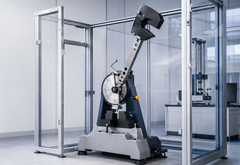





NIST: Foundations for developing new industrial application
Read More

High strain-rate material testing reveals how materials respond to the rapid loading events seen in real-world impacts, which cannot be captured with standard quasi-static tests. HBK provides reliable, high-speed measurement solutions made specifically for transient, high-frequency contexts, capturing accurate data from these critical experiments.
Material properties can change dramatically at high strain rates, compared to their behaviour at quasi-static conditions. To validate design and simulation models, materials must be subjected to rapid loading, such as in crashes, impacts, or explosions.
Examples for material testing methods:
Both tests are extremely short, lasting only milliseconds, and generate high-frequency signals that demand high-speed, reliable, strain-gauge-based data acquisition.
HBK supports high strain-rate testing with data acquisition systems and strain measurement technology designed for highest frequencies. This helps engineers and researchers obtain accurate, usable results from every test, providing essential material data for component testing, impact simulation, and structural validation under dynamic loads.
High-fidelity sensors capture a material's response during high-speed events.
Genesis HighSpeed data acquisition systems capture transient, high-frequency signals with complete confidence.
HBK Perception software provides a complete workflow from setup and acquisition to final analysis and reporting.


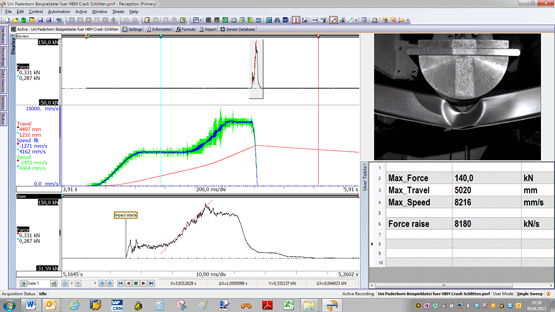

The GenHS DAQ system is a high‑speed measurement solution delivering modular Genesis data acquisition with powerful Perception software for fast testing.

From fatigue testing of an aircraft wing, strain analysis of a printed circuit board, to structural monitoring of a bridge or residual stress measurement, HBK strain gauges for experimental stress analysis are used to determine the level of stress on a material.

A standard testing machine measures material response under slow, quasi-static loading, while an SHPB test measures behaviour under dynamic conditions using wave propagation in bars. This reveals strain-rate effects that do not appear in slow tests.
The Split-Hopkinson Bar test is used to determine material properties, such as its stress-strain response, or Young's modulus, under dynamic loading by analysing elastic wave propagation in instrumented bars.
High strain-rate tests often rely on high-frequency strain measurements, using strain gauges combined with high-speed data acquisition systems and ultra-high-speed video cameras. For more complex testing additional force, displacement or temperature measurements might be needed as well.
Impact events occur over very short timescales and contain high-frequency signal components. Insufficient sampling rates or bandwidth won't reveile the truth and lead to inaccurate results.
High strain-rate data is commonly used to derive dynamic stress-strain behaviour and validate material models for crash, impact, and blast simulations. This requires extensive instant analysis as well as statistical analysis of whole test series.

This will bring together HBM, Brüel & Kjær, nCode, ReliaSoft, MicroStrain and Discom brands, helping you innovate faster for a cleaner, healthier, and more productive world.
