
Genesis HighSpeed (GenHS)
The GenHS DAQ system is a high‑speed measurement solution delivering modular Genesis data acquisition with powerful Perception software for fast testing.
Read More

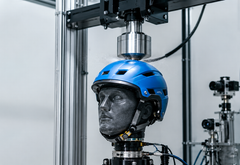
Component crash tests create high-energy events that happen in milliseconds, meaning you need measurement data you can trust the first time. HBK supports reliable, high-speed acquisition for dynamic component and sub-assembly tests, providing accurate force, displacement, and timing data to inform design and validation decisions.
Any data loss during component testing can compromise the results and reduce confidence in validation and simulation correlation.
Whether testing an automotive suspension, a pyro fuse, a protective helmet, an aircraft windshield against a bird strike, or the strength of a ship's window against a rogue wave, you need to capture precise force, displacement, and strain data during a single, often destructive, event.
HBK supports component testing with high-speed data acquisition systems designed specifically for transient measurement. By combining synchronised acquisition, even with different sample rates, deterministic triggering, secure local data storage, and integrated high-speed camera data support, our systems enable engineers to capture clean, reliable data. This provides the crucial experimental evidence needed to validate component behaviour, improve simulation accuracy, and enables making final design decisions regarding a component's intended performance.
Capture the complete physical response of components during high-speed testing in a single system.
High-speed, transient-ready data acquisition systems with local RAM storage, to securely log every critical data point.
Powerful software provides immediate insight and accelerates the post-test workflow.

How does Ghent University simulate bird strikes to protect aircraft? Discover how they use HBK’s ultra-high-speed GEN5i data recorder to set critical technical design constraints and improve aviation safety. Read the full case study now.
Can a cruise ship's window withstand a massive rogue wave? The Hamburg University of Technology dropped a 1,500-liter water splash from 38m to find out, relying on HBK’s Genesis HighSpeed DAQ system for critical data. Download the case study to see how they optimize maritime structural safety.

The GenHS DAQ system is a high‑speed measurement solution delivering modular Genesis data acquisition with powerful Perception software for fast testing.

GenHS input boards enable a real-time testing platform within a multi-channel DAQ system, offering versatile GenHS instrumentation with 20 kS/s to 250 MS/s sampling.

HBK Force Sensors and Force Transducers with strain gauge or piezo technology measure static and dynamic tensile and compressive loads up to 20 MN - with virtually no displacement.
Many force sensors are now available with IO - Link, 4-20 mA or 0 - 10 V output. Use output signal filter below to view IO - link or analogue amplifier options.

From fatigue testing of an aircraft wing, strain analysis of a printed circuit board, to structural monitoring of a bridge or residual stress measurement, HBK strain gauges for experimental stress analysis are used to determine the level of stress on a material.
Component tests allow engineers to study crash behaviour earlier in the design process and at a lower cost, while still applying realistic dynamic loads to critical parts.
Key measurements typically include force, displacement, impact velocity, acceleration, and strain, depending on the test objective.
The primary impact event usually lasts only milliseconds, which is why component crash testing requires high-speed data acquisition and precise triggering to capture accurate readings.
Yes, high-quality measurement data is essential for correlating and improving the accuracy of crash and material simulation models.
Because these tests are often destructive and expensive to repeat, missing data can limit the usefulness of the test, require costly re-runs, and delay project timelines.
High-speed DAQ systems use local memory and onboard storage to ensure all data is captured securely, even under extreme shock, vibration, or a loss of external power or network connections.

This will bring together HBM, Brüel & Kjær, nCode, ReliaSoft, MicroStrain and Discom brands, helping you innovate faster for a cleaner, healthier, and more productive world.