MAIN MENU

Choosing the Right Monitoring Solution for Tunnels and Bridges

As global infrastructure ages, ensuring the safety, reliability, and longevity of bridges and tunnels has never been more important. Structural Health Monitoring (SHM) has evolved from a reactive practice into a proactive, data-driven approach that helps operators better understand how critical assets behave over time.

What you will learn:

  • What's the strategic value of SHM.
  • A real-world case study.
  • How monitoring systems can help asset owners overcome some of the toughest environmental and operational challenges.

Presenter: Arnt-Henning Andersson, Director of Engineering Services at HBK.

Date: April 22, 2025

Duration: 60 min.

Language: English

FAQs - The Strategic Value of Structural Health Monitoring

Arnt-Henning: When we look at structural health monitoring, we generally break the investment down into three main pillars.

First, there is predictive maintenance, which is all about detecting structural damage at an early stage so that issues can be addressed before they escalate. I like to call it being ahead of the game and helping to ensure a safe environment.

Second, there is lifetime prediction. Real-world measurements help engineers predict the remaining service life of a bridge or tunnel. This can support longer certification periods and extended operational life.

Finally, there is design validation, which is especially important for complex or innovative structures, or for assets operating in challenging environments where natural forces can create unpredictable structural behaviour.

Ultimately, an SHM system is an investment in understanding your structure. It provides the insight needed to prevent catastrophic failures, and, most importantly, help protect lives.


Arnt-Henning: We often use a simple green, yellow, and red traffic-light approach.

  • Green: Everything is operating normally
  • Yellow: An anomaly has been detected. This may trigger an action such as reducing train or vehicle speeds, or limiting the volume of traffic crossing the bridge
  • Red: Immediate investigation is required and operations may need to be halted

We always recommend that a red alert should never trigger automatic shutdown based on a single sensor channel alone. Multiple sensor warning should be verified before taking action to avoid costly false alarms.

Arnt-Henning: No two structures are alike, and the challenges can vary enormously.

We frequently deal with large structures, long cable distances, harsh operating environments, and remote locations with limited or slow data connectivity. In many cases, there is no local power supply available, meaning the entire system must operate on batteries.

Managing and storing large volumes of measurement data is another challenge, which is where modern cloud-based solutions play an increasingly important role.

Because there is no universal template for structural health monitoring, our Engineering Services team likes to get involved as early as possible in a project. We carry out a case-by-case assessment of each bridge or tunnel and then tailor a modular monitoring solution that aligns with the customer’s specific needs.

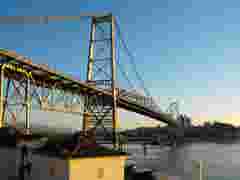
Arnt-Henning: Yes, a great example is the Harrison Bridge in Norway, which provides an important connection between a local island community and the mainland.

During routine inspections, significant cracks were discovered in the concrete structure. As a result, the municipality chose to build a new bridge alongside the existing one, which had to remain safe and fully operational while construction was underway.

To support this, we installed a localised monitoring system consisting of 13 resistive strain gauges (LY61-63 350) mounted beneath the bridge arch, together with Omega sensors (strain gauges mounted on spring steel) positioned across the two largest cracks to measure structural deflection.

Powered by our QuantumX MX1515/MX1516 amplifier platform and catman® software, the system successfully monitored real-time traffic impact, differentiating between lighter vehicles and heavy lorries, providing the municipality with confidence that the bridge could continue operating safely until it was decommissioned.

Arnt-Henning: In a conventional force transducer, we deliberately weaken the internal structure to generate a high signal output, typically up to 4,000 micrometres per metre of strain.

With a bridge or tunnel, we cannot weaken the structure! The signals we are trying to measure are incredibly small, often only 30 to 50 micrometres per metre, peak-to-peak.

At a 2.5V excitation voltage, a strain level of 50 micrometres per metre generates a microscopic electrical output of approximately 0.0625 millivolts.

If that signal then has to travel over 100 metres of analogue cabling, it becomes highly susceptible to interference and signal loss. That is why choosing the right measurement electronics, sensor technology, shielding, and installation approach is so important.

Arnt-Henning: When you are dealing with critical infrastructure such as bridges and tunnels, you cannot afford to rely on assumptions. Real-time data removes much of the guesswork from asset management. Whether the objective is to extend the life of an ageing bridge or validate the performance of a new and complex structure, having that precise, real-time insight means you can make informed decisions, prevent unnecessary shutdowns, and protect the public.

At HBK, we take pride in supporting customers from the earliest stages of a project, helping them find the perfect balance between performance, safety and long-term reliability. The ultimate goal is simple: to ensure that critical infrastructure remains safe, resilient and operational for decades to come.

Related Case Studies

Related Solutions