
Temperature Sensors
Fiber Bragg Grating (FBG) temperature sensors enable multipoint measurements over long distances, even in harsh environments, for reliable monitor
Read More


Challenge
Drill and blast excavation was particularly complex due to challenging geological conditions: — The tunnels were too shallow to form a naturally self-supporting rock arch — The bedrock was exceptionally hard and highly stressed, making blasting unpredictable — Load transfer between rock and structural supports needed to be carefully monitored and controlled during excavation.

Solution
HBK delivered an integrated, real-time fibre‑optic and multi‑parameter monitoring system, combining strain, temperature, and humidity measurements with automated engineering interpretation to support construction decisions and long‑term monitoring.

Result
Continuous, decision‑ready monitoring data enabled safe excavation progress, early detection of deviations and confident verification of structural performance – strengthening risk management during construction and providing a foundation for permanent monitoring.
Trafikverket (The Swedish Transport Administration) is a government agency operating under the authority of the Riksdag and the Government of Sweden. It is responsible for long-term, intermodal infrastructure planning across road, rail, maritime and aviation transport, as well as the planning, construction, operation and maintenance of Sweden’s state-owned roads and railways.
The West Link (Västlänken) is a major infrastructure programme delivered by Trafikverket (Swedish Transport Administration), creating an eight-kilometre double-track railway connection through central Gothenburg. Over six kilometres run through tunnels and include three new underground stations: Centralen, Haga and Korsvägen. Korsvägen is a major transport hub, where the underground station comprises two platforms and four tracks, spanning approximately 30 – 50 metres depending on geological conditions. Structural designer COWI is responsible for the design of the underground station and its structural systems, working closely with Trafikverket throughout both design and construction.
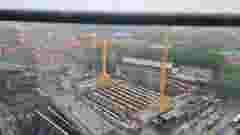
The Västlänken programme introduces a major underground rail connection beneath the city, including the new Korsvägen station.
Excavation in the eastern part of Korsvägen required careful control of load transfer from the surrounding rock mass into the reinforced concrete support structure. Three parallel pilot tunnels were initially blasted, leaving two temporary rock pillars between the excavations to support the surrounding area. These rock pillars were then removed and replaced with cast-in-place reinforced concrete columns. By using this creative construction method, engineers were able to minimise excavation and rock volume movement, reducing both environmental impact and overall project cost. The stability of the surrounding rock mass was also enhanced through grouting: a low-viscosity cement grout was injected into the rock reducing porosity and permeability while increasing stiffness and load-bearing capacity. To ensure structural safety, project stakeholders needed to understand when and how the loads were transferred, while accounting for temperature effects, shrinkage, creep and blasting impacts. The monitoring system also had to deliver clear alert thresholds and limit values linked to structural capacity, enabling excavation to pause or continue with confidence.
Careful excavation sequencing and structural support were required to safely manage rock-load transfer during tunnel construction.
HBK delivered a sophisticated measurement system using fiber optics to monitor stresses and loads in the rock and concrete pillars in real-time. The solution was designed for both the construction phase and long term structural health monitoring. The system includes Fiber Bragg Grating (FBG) strain and temperature sensors installed in reinforced concrete elements, supported by pressure cells, tape extensometers and moisture/relative humidity probes. This combination enables redundancy and cross-checking of results to reduce uncertainty and support robust interpretation. Installation was performed in phases, aligned with the construction sequence. Measurement access was provided during construction, while the final configuration supports permanent monitoring of the structure once the station enters service.
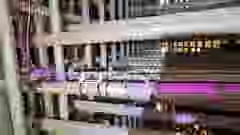
FBG strain and temperature sensors enabled continuous monitoring of structural behaviour during excavation.
Continuous data acquisition is combined with automated post-processing to convert sensor signals into engineering-relevant indicators. Temperature compensation and separation of shrinkage and creep effects allow engineers to isolate strains caused by rock-load transfer. These strains are then translated into stresses, internal forces and utilisation ratios, which are checked against Eurocode 2 interaction criteria. Automated reports provide clear visualisation of trends, alert ranges and stop limits, enabling fast and repeatable decisions during rapid excavation cycles.
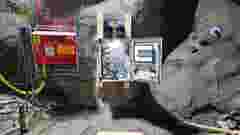
Sensor measurements were converted into actionable indicators supporting excavation decisions and structural verification.
The monitoring system provides Trafikverket and COWI with regular, decision-ready insight throughout excavation. Deviations from expected behaviour can be identified early, investigated through redundant measurements and construction records, and addressed before safety margins are compromised. In practice, this approach has supported confident progress in a complex inner-city underground environment. The combination of fibre-optic sensing, redundant instrumentation and automated interpretation strengthens risk management during construction and creates a validated data foundation for long-term structural monitoring of the station.

Continuous structural insight enabled confident excavation progress while reducing uncertainty and improving risk management.
At Korsvägen station, advanced structural monitoring plays a central role in safe construction of the West Link. By turning raw measurements into actionable engineering insights, HBK’s monitoring solution supports excavation sequencing today while delivering long-term value for asset owners beyond completion.
Long-term monitoring capability was embedded into the structure to support both construction and future operation.

newLight® optical strain gauges offer wide strain ranges, fatigue resistance, easy installation, and durability even in harsh conditions like humidity, rust, and salt.

This will bring together HBM, Brüel & Kjær, nCode, ReliaSoft, MicroStrain and Discom brands, helping you innovate faster for a cleaner, healthier, and more productive world.
