Challenge
A manufacturer of industrial food packaging machinery needed a structured, repeatable approach to improving and demonstrating reliability during in-house testing. As the packaging systems progressed through multiple design iterations and test phases, the team needed a clearer way to establish confidence in reliability results and verify the impact of corrective actions as they were introduced.
Solution
The organisation implemented a structured Reliability Growth Programme supported by ReliaSoft Weibull++, enabling engineers to plan, manage, and analyse reliability growth testing consistently across multiple development phases and design updates.
Result
This approach provided continuous visibility into reliability growth progress, enabling earlier confidence in MTBF (Mean Time Before Failure) achievement, reducing overall test time, and removing the need for separate demonstration testing - supporting faster, evidence-based engineering decisions.
A global provider of advanced processing and packaging solutions for the food, dairy, and beverage industries operates a Development & Technology organisation responsible for developing filling machines, downstream equipment, and automation systems used in complete production plants. The Reliability Engineering team plays a central role in ensuring these complex, repairable systems meet demanding performance expectations before deployment.
The organisation develops complex, repairable production equipment used in demanding industrial environments across the food, dairy, and beverage sectors. Within Development & Technology, the Reliability Engineering team plays a critical role in supporting engineering decisions through risk analysis, reliability testing, and structured performance evaluation.
As systems evolve through redesigns, upgrades, and corrective actions, maintaining confidence in achieved reliability requires more than traditional validation testing alone.
To address this, a Reliability Growth Programme (RGP) approach was adopted, enabling reliability to be progressively improved and demonstrated across controlled test phases rather than assessed only at the end of development.
Successfully implementing this strategy required a consistent framework for planning test duration, tracking failures, and maintaining confidence in results as improvements were introduced throughout the test lifecycle.

To support this structured methodology, ReliaSoft Weibull++ Reliability Growth software was adopted as the analytical backbone of the in-house RGP testing process.
The software enabled engineering teams to plan reliability growth tests in advance, including estimating required test duration and target MTBF before testing began. During execution, failure events could be recorded, classified, and analysed consistently across multiple test phases, supporting a clear and traceable reliability improvement process.
ReliaSoft Weibull++ supports recognised reliability growth models, including Crow-AMSAA and extended continuous evaluation approaches, allowing reliability performance to be assessed continuously as corrective actions were implemented. Combined with a defined organisational setup covering test execution, root cause analysis, and structured data tracking, this ensured decisions were based on repeatable engineering evidence rather than isolated test results.
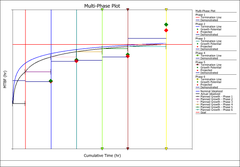
By embedding reliability growth analysis directly into its development workflow, the organisation gained continuous visibility into achieved reliability compared with planned expectations throughout testing.
MTBF could be evaluated at each test phase with confidence bounds applied directly to measured data, enabling reliability targets to be demonstrated earlier in the development cycle without requiring separate demonstration testing.
This approach reduced overall test duration while increasing confidence in performance outcomes. Reliability Growth Programme testing supported by ReliaSoft Weibull++ is now embedded as a standardised engineering procedure. The ability to stop testing early when reliability targets are met further improves efficiency, allowing teams to focus resources where they deliver the greatest impact.
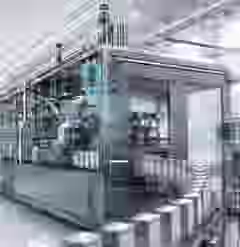
Data-driven precision in action: A state-of-the-art packaging machine, showcasing advanced reliability monitoring in a modern food and beverage facility
RGA Plot Example