

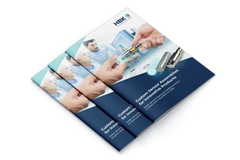
Download The Guide of Custom Sensor Solutions
Read More

The robotics industry has made extraordinary progress in vision, navigation, planning and artificial intelligence. Yet every useful robotic task eventually becomes physical. A gripper closes around a component. A mobile platform accelerates with a changing payload. A cobot touches a workpiece. A legged robot transfers its weight from one contact point to another.
At that moment, the quality of the robot’s decisions depends not only on what its software predicts, but also on what the machine can actually measure.
We spoke with Max Linardi about the role of physical sensing in robotics, why successful integration begins with mechanical design, and what robotics OEMs should expect from a true sensor-development partner.
“A model tells the robot what should be happening. A sensor tells it what is happening.”
Max Linardi: Because autonomy only creates value when a robot can perform useful physical work. A planner may generate an excellent trajectory, but the task succeeds only if the machine applies the right force, handles the actual load, remains stable and reacts when reality differs from the model.
The object may be heavier than expected, its centre of gravity may be offset, a part may be slightly misaligned, friction may change, a gripped component may begin to slip, or an external load may act on the structure. These are not exceptional situations. They are normal variations in the physical world.
A model tells the robot what should be happening. A sensor tells it what is happening. The next step in robotics is not choosing between those two sources of information, but combining them. As tasks become more variable, dynamic and interactive, the cost of guessing continues to rise.
Max Linardi: Not at all. Models, observers and current-based estimates are essential tools, and in many applications they are entirely sufficient. A credible sensor supplier should not argue that every robot needs additional measurement channels.
The real question is where model uncertainty starts to limit performance. An estimate can depend on friction, transmission efficiency, backlash, temperature, wear, cable forces, acceleration and the assumed payload. Those parameters change over time and can vary from one machine to another.
Direct measurement provides an independent observation of the physical load path. That can improve control, but it can also support calibration, diagnostics, process verification and failure analysis. In many high-performance systems, the best results comes from combining strong models with trustworthy measured data.
Max Linardi: Wherever physical uncertainty is preventing a robot from working faster, more delicately, more reliably or with less commissioning effort.
In an industrial arm, joint-torque or end-of-arm force/torque measurement can support contact detection, insertion, assembly, finishing and compliant motion. In a gripper, force measurement can confirm a successful pick, detect a double pick or identify the onset of a slip.
In mobile robotics, payload and load-distribution data can support load verification, stability monitoring and payload-adaptive motion. In humanoids and quadrupeds, force and inertial measurements help the controller understand contact, balance and impact.
The same data can also create value beyond control by revealing overload events, process deviations, wear or changes in the mechanical system.
The goal is not to put a six-axis sensor everywhere. A good sensing architecture is not the one with the most channels. It is the one that measures the decisive physical variables with the accuracy, dynamics and robustness the application actually requires.
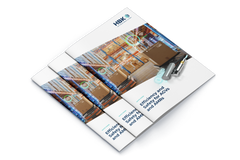
A model predicts, but a sensor measures. Relying on algorithms alone isn't enough for complex dynamic loads. Overcome integration challenges by embedding custom sensors early in your OEM design phase.
Discover how advanced force measurement boosts stability, safety, and overall robot efficiency.
Max Linardi: Robotics asks a sensor to satisfy requirements that naturally compete with one another. The structure should be stiff, compact and lightweight, yet a strain-gauge sensor needs a small and repeatable elastic deformation to generate a useful signal. The system may need high sensitivity for delicate contact while also being capable of surviving a crash, emergency stop or a severe overload.
At the same time, the measurement must remain stable over temperature and millions of operating cycles, distinguish intended loads from parasitic loads, fit within a tightly constrained envelope and avoid compromising payload, stiffness or serviceability.
This is why mechanical integration is not simply a packaging exercise. The load path, geometry, material, mounting conditions and strain-gauge layout determine whether the measurement will be useful long before the electronics or software ever see the signal.
Max Linardi: We do not start with a catalogue part. We start with the decision the robot needs to make and the physical information that is missing.
Sometimes a standard transducer is the right answer. In other cases, the best solution is to instrument an existing component or develop a sensor geometry around the architecture of the machine.
A joint component, shaft, pin, mounting plate, structural link or part of the chassis can be engineered to become the sensing element. Finite-element analysis helps us identify useful strain fields, stress concentrations and parasitic sensitivities. From there, we optimise geometry, material, strain-gauge arrangements, compensation, overload protection and calibration around the real operating conditions.
The best custom sensor often disappears into the machine. Instead of becoming an additional component with its own mass, interfaces and installation space, the measurement function becomes part of the robot itself.

A model predicts; a sensor measures. Relying on standard parts limits a robot's ability to handle complex dynamic loads. To achieve true physical intelligence, seamless integration is key. See how embedding bespoke force measurement early in your design phase maximizes performance and safety.
Max Linardi: They need predictable performance in the real application.
A laboratory accuracy figure under one static load says very little about behaviour under combined loads, changing temperature, vibration, shock, creep, hysteresis, fatigue or overload. Mounting flatness, bolt preload and production tolerances can also influence a high-precision measurement.
The requirements therefore need to reflect the real duty cycle, including nominal loads, load combinations, overload conditions, environmental factors, service life, bandwidth, cross-talk, zero stability, drift, repeatability and how the signal will ultimately be used.
A measurement system intended for development testing has different priorities from one that continuously supports control or condition monitoring.
Then there is industrialisation. An OEM does not need one exceptional prototype; it needs every production unit to behave predictably. Calibration time, manufacturing tolerances, traceability, quality controls, design changes, cost and long-term availability all need to be considered early. A brilliant prototype that cannot be produced reliably is not a successful sensor solution.
Max Linardi: The complete measurement chain.
Static accuracy alone does not tell you whether a signal is useful in a dynamic application. The mechanical structure has its own resonances. Signal conditioning, sampling, filtering, noise, timing, synchronisation and latency all influence what the controller ultimately receives.
A protocol name is not a control strategy. The important question is what decision the robot must make, how quickly it must make it, and what level of uncertainty is acceptable.
Detecting the onset of slip requires a different dynamic response from measuring payload mass. Contact control during assembly has different requirements from long-term structural monitoring.
Robots also rarely experience one clean load at a time. Forces and moments act simultaneously, and cross-talk must be distinguished from genuine mechanical coupling. Geometry, strain-gauge placement, multi-axis calibration and, where appropriate, matrix compensation all contribute to generating trustworthy data across the load combinations the robot will actually experience.
The objective is not the fastest signal or most heavily filtered one. It is the right signal for the control decision.
Max Linardi: They can provide valuable information for collision detection, force limitation, overload monitoring, stability monitoring and defined process reactions. But a sensor alone does not make a robot safe, and it is important not to market it that way.
Safety is a system property. It depends on the risk assessment, mechanical design, architecture, diagnostics, fault handling, control systems, software and validation processes. A measurement used in a safety-related function must be integrated and assessed within that broader concept.
Our responsibility as a sensor partner is to provide reliable physical information, understand relevant failure modes, support diagnostics and help OEMs develop a measurement concept that can be verified in the final system.
Precision also means being precise about the limits of what a component can guarantee.
Max Linardi: A development partner should understand the interaction between mechanics, metrology, electronics, control requirements and manufacturing.
It should be able to discuss load paths with the mechanical team, signal behaviour with the controls team, failure modes with the safety team and repeatability with production engineering.
That is where HBK is particularly relevant to robotics. We combine decades of experience in strain gauges and physical measurement with expertise across force, torque, load, acceleration, vibration and inertial sensing. We can support the measurement chain, from sensing element and mechanical design through signal conditioning, calibration and validation.
Just as importantly, we can support programmes from initial feasibility studies and simulation through prototyping, application testing and repeatable series production.
Robotics companies do not need a supplier that delivers a component and disappears. They need a partner who remains invested in the quality of the measurement as the platform evolves.
Max Linardi: Do not add sensing because it is fashionable.
Start with the physical uncertainty that is forcing conservative margins, slower motion, additional commissioning, higher reject rates or limited autonomy. That is where measurement can create real technical and commercial value.
Treat the measurement function as part of the architecture. Decide what the robot must know, identify where that information exists in the load path, define the required uncertainty and dynamic performance, and validate the complete measurement chain under real operating conditions.
Involve the sensor partner before every mechanical interface is frozen. That is when the most elegant and cost-effective solutions are still possible.
The next generation of robotics will not be built by software or hardware alone. It will be built by machines that combine powerful models with trustworthy information from the physical world.
A robot becomes genuinely capable when it can compare what it intended to do with what actually happened.
“A robot becomes genuinely capable when it can compare what it intended to do with what actually happened.”

This will bring together HBM, Brüel & Kjær, nCode, ReliaSoft, MicroStrain and Discom brands, helping you innovate faster for a cleaner, healthier, and more productive world.