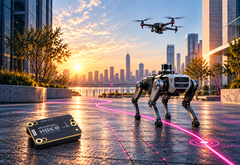
Autonomous platforms operate in environments where vibration, shock, rapid motion and temperature variations can affect inertial measurements and compromise attitude and navigation estimates. For system designers and engineers, the challenge is not simply achieving accuracy under ideal conditions but maintaining reliable motion information and navigation data while meeting strict size, weight, power and integration requirements.
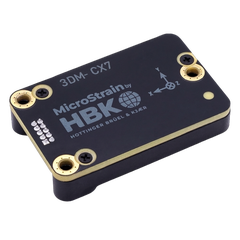
The MicroStrain 3DM-CX7 family addresses these challenges through a redundant multi-IMU architecture, intelligent outlier rejection, an auto-adaptive Extended Kalman Filter, and individual calibration across the full operating temperature range.
Available in three configurations (AR, AHRS and INS), the CX7 Series provides attitude, heading and aided navigation capabilities tailored to different autonomous system architectures.
The CX7 series combines low gyro bias instability, extended inertial measurement ranges and high-rate data output in a compact package designed for demanding autonomous platforms.
Different autonomous platforms require different levels of motion and navigation capability. The CX7 family provides three configurations built on a common architecture, allowing engineers to select the functionality that matches their system requirements.
Compare the three configurations according to the motion information your system requires, from attitude and relative heading to magnetic heading and externally aided inertial navigation.
Capability | CX7-AR | CX7-AHRS | CX7-INS |
Roll and pitch | ✓ | ✓ | ✓ |
Relative heading | ✓ | ✓ | ✓ |
Magnetic heading | — | ✓ | ✓ |
Position and velocity estimation | — | — | ✓ |
External navigation aiding | — | — | ✓ |
RTK compatibility | — | — | ✓ |
Redundant multi-IMU | ✓ | ✓ | ✓ |
Adaptive EKF | ✓ | ✓ | ✓ |
MIP protocol | ✓ | ✓ | ✓ |
NMEA protocol | — | — | ✓ |
RTK positioning requires an external compatible GNSS receiver.
From UAVs to mobile robotics, the CX7 family supports applications where vibration, rapid motion and changing operating conditions place demanding requirements on inertial estimation.
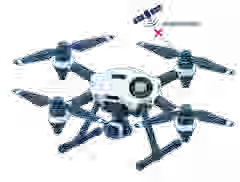
Support attitude and navigation estimation under propulsion-induced vibration, dynamic manoeuvres and changing GNSS availability.
Provide dependable attitude information for robots experiencing rapid motion, repeated impacts and high-dynamic operating conditions.
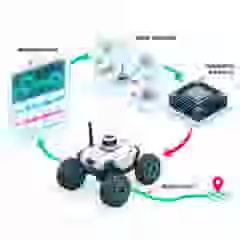
Combine inertial measurements with available external aiding to support reliable attitude and navigation estimation in demanding operating environments.
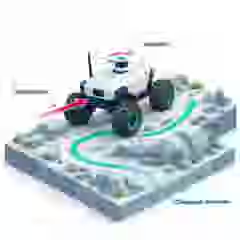
The CX7 family combines compact hardware, flexible communication and MicroStrain’s software ecosystem to support sensor evaluation, configuration and integration into autonomous platforms.
ROS and PX4 Integration
Dedicated drivers support established robotics and autopilot environments, enabling access to inertial data for sensor fusion, navigation and control.
MSCL API and MIP SDK
Open-source development tools provide documented interfaces and example code for sensor communication and embedded integration.
InertialConnect and SensorConnect
Configure sensors, adjust parameters, collect data and visualise measurements using dedicated desktop software.
Synchronization and Event Management
External clock synchronization and configurable GPIO support time alignment and event management within multi-sensor systems.
This will bring together HBM, Brüel & Kjær, nCode, ReliaSoft, MicroStrain and Discom brands, helping you innovate faster for a cleaner, healthier, and more productive world.