




In the world of critical infrastructure, control rooms are often flooded with data, yet starved of true, actionable insights. For maintenance managers and operators, the daily reality is a delicate and often stressful balancing act. On one hand, there is the constant concern of missing a slow-developing but potentially catastrophic asset failure. On the other,there is the exhausting volume of nuisance alarms generated by over-sensitive monitoring systems.
This tension highlights one of the biggest challenges in predictive maintenance: balancing sensitivity and reliability. If a model is tuned to be too sensitive, it flags every minor fluctuation, leading to alert anomalies, where operators eventually ignore the very warnings designed to protect them. However, if sensitivity is reduced too much, there is an unacceptable risk of missing the gradual and subtle degradation that often precedes a major failure.
Resolving this conflict requires moving beyond the traditional approach of relying on rigid, fixed thresholds. In the real world, assets do not operate in a vacuum; they respond continuously to their environment. A healthy machine operating under heavy load in the middle of the day can look very different from the same machine idling at night. Consequently, the starting point must be to establish a dynamic, adaptive baseline of normal behaviour that constantly adjusts to changing condi-tions. Asset behaviour should be evaluated in the context of factors such as operating state, load, temperature, and other environmental and operational conditions.
However, data and algorithms alone are not enough to calibrate these baselines effectively. True validation requires a continuous feedback loop that combines quantitative metrics with human expertise. We must actively monitor performance indicators, particularly false positives and missed detections, and compare them against known event logs, such as physical inspection findings and the deep domain knowledge of our engineering teams.
Furthermore, we must apply physics-informed constraints to our algorithms. By embedding the underlying laws of physics, we can quickly determine whether a detected anomaly is consistent with real-world engineering behaviour or simply a digital anomaly.
Ultimately, the goal of a modern monitoring system is not to detect every microscopic deviation from the norm. The real objective is to identify the anomalies that matter, filter out the noise, and provide maintenance teams with reliable, high-confidence insights that enable timely, preventative action.
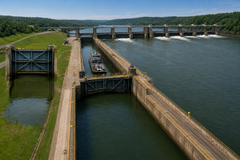
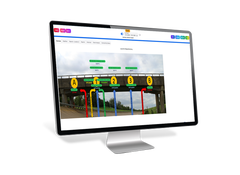
Discover how HBK Monitor360 helped the U.S. Army Corps of Engineers detect early structural degradation, reduce maintenance risk, and move from reactive inspections to predictive, AI-driven asset management.
An engineering led, AI-enabled approach to optimising infrastructure assets.