MAIN MENU
usp-icon

A major global mining company needed to maintain haul truck availability as hauling distances increased, placing greater operational demands on its fleet. The organization needed a data-driven maintenance strategy to reduce downtime and sustain production performance.

usp-icon

Using our specialized ReliaSoft reliability engineering software, the company conducted a comprehensive RAM analysis of its haul truck fleet. Multiple maintenance scenarios were modelled to identify the optimal balance of reliability, availability, maintenance cost, and operational risk.

usp-icon

The optimized maintenance strategy improved physical availability, reduced mean time to repair, and delivered significant financial value. The analysis estimated $4.6 million in production gains per truck, with a return on investment of 403%.

Understanding the Impact of Changing Operating Conditions

The mining operation was experiencing a significant change in operating conditions. As the distance between the mine and the primary crusher increased, haul trucks were required to work harder and for longer periods, placing additional stress on critical systems and components.

To maintain production targets, the company needed a clearer understanding of how these changing conditions would affect fleet availability throughout the asset lifecycle. It also needed to identify which systems and components were contributing most to downtime and determine the most effective maintenance approach to maximize performance while managing cost and risk.

Using RAM Analysis to Optimize Maintenance Strategy

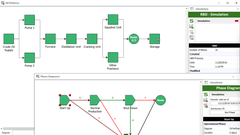
To support decision-making, the company conducted a comprehensive Reliability, Availability and Maintainability (RAM) analysis using ReliaSoft's BlockSim, RCM++, and Weibull++ reliability engineering software.

The study incorporated failure data collection and analysis, failure mode classification, Life Data Analysis, Recurring Data Analysis, Reliability Block Diagram modelling, system criticality assessments, optimized replacement calculations, and maintenance scenario simulations.

Two alternative maintenance strategies were evaluated:

  • A conventional approach based on inspections, scheduled maintenance activities, and on-condition component replacement.
  • An optimized strategy combining scheduled inspections, fixed-time replacement of selected components, and overhaul of peripheral systems where appropriate.

Long-term simulations were used to evaluate fleet performance under each strategy and to develop recommendations for maintenance planning, replacement intervals, spare component requirements, risk mitigation, and preventive maintenance activities.

Delivering Higher Availability and Strong Financial Returns

The analysis conducted via the ReliaSoft software suite demonstrated that the optimized maintenance strategy could significantly improve fleet performance.

Simulation results indicated an estimated increase of 3.6 percentage points in average physical availability, while also reducing the rate at which availability declined over the asset lifecycle. The financial evaluation demonstrated a compelling business case for the optimized RAM-based maintenance strategy. By increas ing physical availability, the analysis estimated $4.6 million USD in production gains per truck. Based on an additional investment of $900,000 per truck, the projected return on investment was 403%.

Following implementation, the operation achieved measurable improvements in physical availability and reduced mean time to repair, helping support continued production performance under more demanding operating conditions.

Data driven maintenance optimisation

Technology Used