


MAIN MENU

Have you ever tried measuring vibration on a spinning bicycle wheel or a flying drone’s propeller using traditional accelerometers? If you have, you know the nightmare: heavy data acquisition systems, cables wrapping around spinning hubs, altered aerodynamics, and the constant risk of wires tangling or snapping.

Recently, HBK team set out to prove that these physical limitations are a thing of the past. Taking advantage of the streets around our headquarters in Virum, Denmark, we launched a practical test campaign using the new HBK Molecu wireless accelerometers.

The goal? To show that we can easily capture raw, sample-synchronous vibration data from locations that were previously completely inaccessible.

The mission: if it works on a wheel, it works on a wing

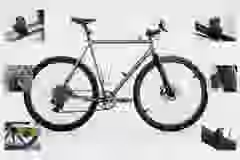
A high-performance sport bicycle featuring a titanium frame and carbon components has both highly rigid structures and rapidly rotating elements (the pedals and wheels), serving as the perfect testbed.

Wireless bicycle drivetrain monitoring with Molecu

The setup: no cables, just tape, glue and adaptors

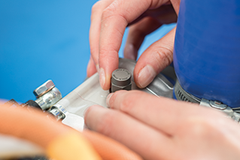
To mount the compact Molecu sensors (measuring just under 2 cm on each side and weighing just 22 g), we used a brilliantly simple approach:

  1. We applied Kapton tape to the bicycle to protect its premium titanium and carbon surfaces.
  2. We attached custom 3D-printed mounting adapters directly onto the tape using super glue.
  3. We glued our standard mounting clips onto the adapters.
  4. The Molecu sensors were then clicked securely into the clips.

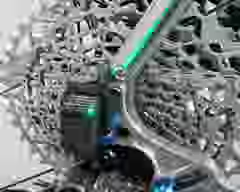
In total, seven sensors were mounted across critical points of the bike, including the handlebar, seat post, frame downtube, pedal, and – most importantly – directly onto the rotating wheel hubs and rims.

Molecu sensors for bicycle performance monitoring
knowledge, resource center, articles, real time noise measurements

Article: Wireless Data Acquisition Unleashed

Perfectly synchronized real-time sound and vibration measurements over large areas are simplified with independent, wireless Data Acquisition Modules. It's time to unleash absolute flexibility. Discover more in this article.

Out on the streets of Virum: normal vs. low pressure

Each test run lasted exactly 35 seconds. The rider pedalled up to speed, rolled over a street kerb, made a sweeping turn, hit the kerb a second time, and finally braked to a smooth stop.

To make things interesting and see if the sensors could detect subtle physical changes, we ran the exact same test route under two different conditions:

  1. Normal pressure: Tyres fully inflated to a firm 2.8 bar.
  2. Lower pressure: Tyres deflated to a softer 1.5 bar to introduce natural mechanical damping.
Molecu key applications 05

Crunching the curves in BK Connect®

Back in the lab, we imported the datasets into BK Connect® for post-processing. The results clearly demonstrated the damping effect of the lower tyre pressure:

  • The ride comfort (handlebar and seat post): Comparing the two test runs, the damping effect of the 1.5 bar tyre pressure was instantly visible in the time-domain curves – significantly reducing the harsh shockwaves transferred to the rider’s hands and body
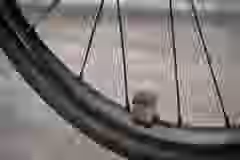
  • Measuring the rotating wheel: Measuring directly on the wheel rim is incredibly difficult because the accelerometer constantly changes its orientation relative to gravity as the wheel spins. However, this is also where the Molecu truly shined. By capturing unfiltered vibration right at the interface between the road and the tire, the team got the most direct data possible

Even better, because of gravity’s cyclic effect on the rotating sensor, the low-frequency component of the raw signal naturally tracked the wheel’s rotation speed. This means the accelerometer doubled as its own tachometer – no extra tacho probes required!

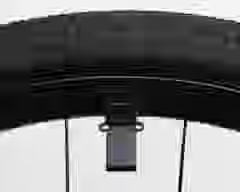
Rear view of the molecu wheel rim installation

Advanced analysis: reconstructing the frame’s movement

To take the campaign a step further, the HBK team linked the sensor data to a simplified geometric model of the bicycle frame. Using BK Connect®, the team performed:

  • Operational Deflection Shapes (ODS): Animating how the bicycle frame physically flexes and vibrates under real riding conditions
  • Operational Modal Analysis (OMA): Successfully extracting three natural vibration modes and mapping the frame’s exact natural frequencies and damping behaviour
How does Molecu work

The veredict: cable-free is the future

This quick test campaign proved exactly what the team hoped: the HBK Molecu wireless accelerometer delivers high-fidelity, sample-synchronous data comparable to traditional wired setups, but with a fraction of the installation time and zero cabling constraints.

By successfully measuring a spinning bicycle wheel on the roads of Virum, we have opened the door to a massive range of new testing possibilities. From rotating helicopter blades and drone propellers in mid-air, to wind turbines and complex industrial machinery – the future of vibration testing is officially cable-free.

You May Also be Interested In