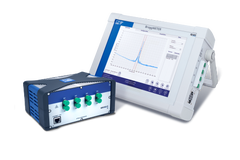
The FS65ACC accelerometer, based on Fiber Bragg Grating (FBG) technology, measures vibrations at low frequencies from 0 to 50 Hz. It is perfect for monitoring applications where low-frequency but significant amplitude vibrations occur, such as load-induced vibrations in civil structures or ambient cable vibrations. Multiple accelerometers can be combined for simultaneous multi-axis measurements.
Optimized for measurements at low-frequency vibrations (0–50 Hz) with remarkable flatness and stability.
Ideal for civil structures and cable systems, with the ability to combine multiple sensors for multi-axis measurements.
Immune to electromagnetic interference delivering low noise measurements.
| newLight FS65 - Caractéristiques techniques | Data Sheets | English |
| newLight FS65 - Caractéristiques techniques | Data Sheets | Japanese |
| newLight FS65 - Caractéristiques techniques | Data Sheets | French |
| newLight FS65 - Caractéristiques techniques | Data Sheets | German |
| FS65ACC - Notice de montage | Mounting Instructions | English |
| newLight FS65 - Notice de montage | Mounting Instructions | German |
| FS65ACC newLight - Notice de Montage | Mounting Instructions | French |
| newLight FS65 - Notice de montage | Mounting Instructions | Japanese |
Sales documents
| Optical Measurement - Brochure | Brochure | English |
| Type/technology | Fiber Bragg Grating |
| Direction/Axes | Uniaxial |
| Measurement range | 100 m/s² |
| Measurement range | 10 g |
| Application | General purpose, Speciality |
| Weight | 338 g |
| Weight | 12 oz |
| Sensitivity | 59 pm/g |
| Lower frequency | 0 Hz |
| Higher frequency | 50 Hz |
| Minimum Temperature | -20 °C |
| Maximum Temperature | 80 °C |
| Minimum Temperature | -4 °F |
| Maximum Temperature | 176 °F |
| Mounting | Center bolt mounting |
| Resonance frequency | 0.43 kHz |
| Electric isolation | None |
| Output signal (connectivity) | Analogue |
| Electrical connector location | Integral cable |
| TEDS | No |
| Filtering | None |
List of accessories available for all variants of this family
Capteurs à fibres optiques vs Jauges de contrainte électriques pour les applications de surveillance des infrastructures