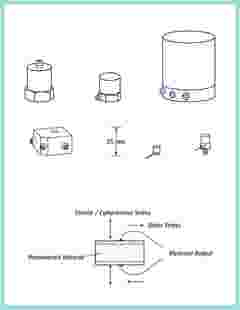
Most manufacturers have a wide range of accelerometers at first sight, maybe too many to make the choice easy.
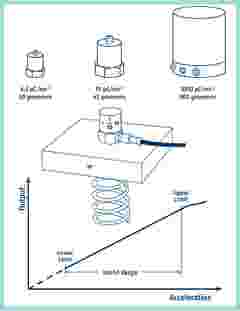
A small group of "general purpose" types will satisfy most needs. These are available with either top or side-mounted connectors and have sensitivities in the range from 1 to 10 mV or pC per m/s2. The Brüel & Kjær Uni-Gain® types have their sensitivity normalized to a convenient "round figure" such as 1 or 10 pC/ms-2 to simplify calibration of the measuring system.
CCLD/DeltaTron® or IEPE Accelerometers
CCLD (Constant Current Line Drive) Accelerometers or IEPE (Integrated Electronics Piezo Electric) accelerometers are piezoelectric accelerometers with integral preamplifiers, which give output signals in the form of voltage modulation on the power supply line.
Brüel & Kjær's IEPE accelerometers have a high output sensitivity, high signal-to-noise ratio, and wide bandwidth make them suitable for both general purpose and high-frequency vibration measurements.
These accelerometers are high-performance instruments that have higher output sensitivity than standard piezoelectric accelerometers (without integral amplifiers). They are hermetically sealed to protect against environmental contamination, have low susceptibility to radiofrequency and electromagnetic radiation, and low impedance output due to the external constant current power source. The low-impedance output allows you to use inexpensive coaxial cables for accelerometers.
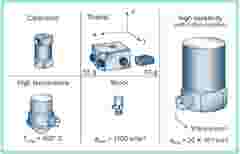
Many of the accelerometers outside the general purpose range have their characteristics slanted towards a specific application. An example; small accelerometers that are intended for high level or high-frequency measurements, and use on delicate structures, panels, etc. that weigh ca. 0,5 to 2 grams.
Other special-purpose types are optimized for simultaneous measurement in three mutually perpendicular directions; high temperatures; very low vibration levels; high-level shocks; calibration of other accelerometers by comparison; and permanent monitoring on industrial machines.