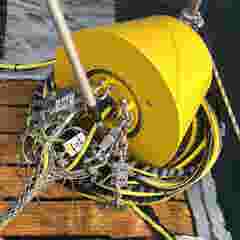
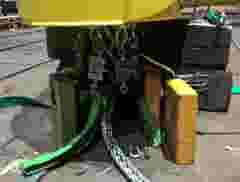
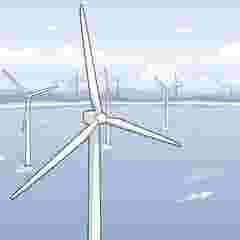
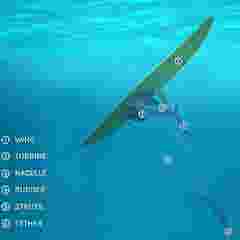
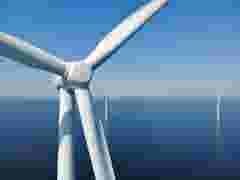
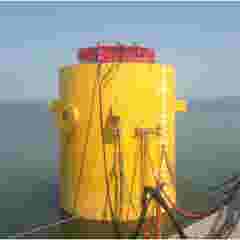
“Our turbines will be exposed to very high wind speeds of up to 25 meters per second, which is a really heavy storm,” explains Martin Bode, “the anchoring cables also need to withstand high waves of up to 17 meters.” Strong waves are likely to occur off the coast of Kurahashi, too, which can subject the anchoring cables to very high tensile loading temporarily. The S9M is extremely accurate, even with high capacities.
Therefore, a sensor with a higher capacity can be used in applications where high overloads are likely to occur. The sensor’s excellent performance guarantees highly precise measurement results.
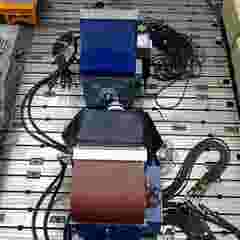
Besides the S9M force sensor, aerodyn engineering uses additional accessories such as the matching knuckle eyes that are optimally tailored to the sensor’s capacity.
The wind power experts additionally use the U9C miniature load cell to measure the tensile loading of the rotor tower’s three guy ropes.
Due to its high dynamics and robust stainless-steel measuring body, it precisely acquires load changes in the guy ropes over a long period of time.
"We offer a wider range of sensors and measurement electronics for every requirement,” says Christoph Miks. “We provide our customers with technology comprising the complete measurement chain from a single source, ranging from the sensors to the measurement electronics and matching installation accessories.” aerodyn engineering has relied on HBK’s extensive expertise in sensors and testing and measuring technology for several years.
"We need a partner that joins us in breaking new ground and promoting our innovative wind energy concepts,” says Martin Bode, “The HBK experts advise us and provide us with high-grade, dependable technologies that make our prototype test runs more efficient and reliable.
We benefit from HBK’s global presence in our tests worldwide, for instance, when spontaneous measurement missions require rapid deployment.”