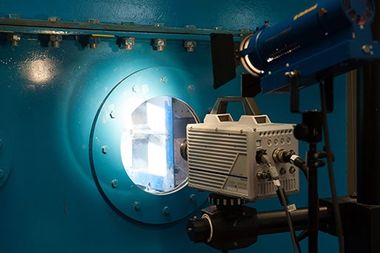
Historically, engineers have analyzed data from similar experiments by using static, procedural scripts in languages such as Fortran or Matlab. However, Genesis HighSpeed and HBK’s associated software with excellent graphical user interfaces (GUI) have given engineers new tools to utilize. Also engineers tended to perform tests, analyze the data, and then make only the processed data available. However, HBK provides an extensive relational database enabling researchers to store original data, along with processing parameters, and reprocess the data in real time as needed. This is very useful when producing stress/strain curves from Split Hopkinson Bar data. Utilizing the Genesis HighSpeed equipment means the data can be accessed over a network via a file server or installed on a laptop PC and used in stand-alone mode enabling the complete test record to be readily retrieved. An example of the usefulness of this capability is Data PADS, which interactively recomputes stress/strain relationships and other data curves under various assumptions by storing both the raw strain gauge data and metadata describing how the strain gauge data should be processed. The NIST-developed Data PADS also includes a database containing visible high speed video, thermal camera video, high speed pyrometer data, sensor data on the projectile’s velocity, as well as technical papers and associated information. In addition the software has to be able to permit access by multiple users who might be performing different types of tests with the system in various configurations. In addition to the normal one-dimensional data such as calibration constants and test conditions, the NIST Split Hopkinson Bar equipment produces a wide range of both two-dimensional data such as current, temperature, projectile position and strain gauge data vs. time. Three-dimensional data such as thermal images and visible light images against time can also be produced to give a comprehensive range of data.