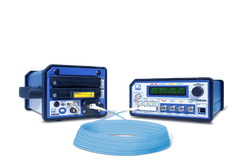
HBK has supplied three transient recorders from the Genesis High Speed range to the KEMA High Voltage Laboratory at DNV GL in Arnhem. The new data acquisition systems replace the LDS Nicolet equipment that KEMA Laboratories acquired between 1995 and 2000 and used until recently. The main reason for changing over to new measuring equipment was the application of the IEC 60060-2 (2010) standard, which provides guidelines for performing high-voltage tests and the requirements concerning measuring technology.
Power failures have significant consequences
In the High Voltage Laboratory we have focused on testing and certificating HV components, power equipment and metering, protection and control equipment for the generation and distribution of electricity. Testing and certifying the safety and control of high-voltage installations and systems is becoming increasingly important, because the electricity infrastructure is getting more and more complex and vulnerable. Power failures have significant consequences, ranging from considerable economic damage to life-threatening situations as a result of the failure of critical systems.
"We have built up a considerable reputation in the field. Our KEMA Type Test certificates are internationally recognised.”
John Mooren, test engineer at KEMA Laboratories in Arnhem.
Dielectric tests
Dielectric tests are carried out using, among others, alternating current (AC), direct current (DC) and lightning impulse (LI). The HBK transient recorders are used to record tests with lightning impulse. A standard lightning impulse voltage waveform has a front duration of 1.2 microseconds and a time to half value of 50 microseconds. The HBK transient recorder system has a very high measuring speed of 10 nanoseconds. The front duration of a waveform is determined by taking approximately 120 measurements in 1200 nanoseconds. The peak voltage of a lightning waveform is evaluated using software formulae that conform to IEC 60060-2. This software is part of the HBK computer system that processes the measurement data, and the transient recorders from the HBK Genesis High Speed range are extremely suitable for this task.
Lightning surge voltage
The lightning surge voltage is created by an impulse voltage generator, which consists of a number of 100 kV (or 200 kV) capacitors that are charged and then discharged in series. There are a total of three impulse voltage generators in the High Voltage Laboratory. The maximum voltage achievable is 2.6 MV (13 capacitors of 200 kV each), and voltages of 1.6 MV and 1 MV (16 and 10 capacitors of 100 kV each respectively) are also possible. The peak value of the impulse voltage is established in accordance with international standards. The peak value of the impulse voltage for 400 kV high-voltage systems is 1425 kV, and for 12 kV medium-voltage systems it is 75 kV. The laboratory contains six high-voltage dividers, which are used to measure impulse voltages. Each divider has its own digitizer transmitter, and there are also two measuring systems with which secondary signals can be measured. There are a total of eight transmitters and three receivers, plus three HBK PCs/measuring systems. Another new feature was the separation of data acquisition and the transfer of the measurement data to a PC via optical fibre. This has many benefits because it eliminates interference, which makes the measurement data more accurate. Safety is also improved, because the flash-over of high voltage via optical fibre is not possible. Exposure to such voltages is fatal.