

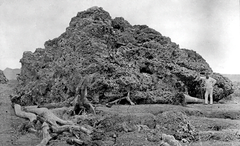

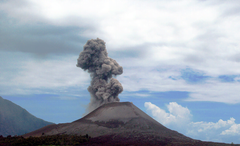
The loudest sound in recorded history came from the volcanic eruption on the Indonesian island Krakatoa at 10.02 a.m. on August 27, 1883. The explosion caused two thirds of the island to collapse and formed tsunami waves as high as 46 m (151 ft) rocking ships as far away as South Africa.
The explosion was reportedly heard 4800 km (3000 miles) away, where people described the sound as "cannon fire from a nearby ship”.
Nature is a law unto itself, and there is nothing we can do to combat its extremities, in this case, extreme sound. However, we can do something about sounds created by man.
Read about the deafening noise in Europe where new laws and standards are constantly taking shape.
The Batavia gasworks (North Jakarta), 160 km (99 miles) away from the source, registered a sound pressure level spike of more than 2½ inches of mercury (8.5 kPa), equivalent to 172 decibels. The sound pressure wave travelled the globe seven times in total over the following five days.
In comparison Microphone Type 4966-L-001 is designed for high sound pressure level (SPL) measurements – such as in the proximity of a jet engine - and provides a dynamic range of 144 dB.
Sound power is the total airborne sound energy radiated by a sound source per unit of time. Sound pressure, on the other hand, is the result of sound sources radiating sound energy that is transferred into a specific acoustical environment and measured at a specific location.
Sound power is the cause, and sound pressure is the effect. Understand the differences in this article.
Un ensemble de microphones comprend une paire de capsules microphoniques HBK associée au Préamplificateur microphonique idéal. Chaque ensemble de microphones est doté d'un identifiant unique et d'une puce mémoire, scellés pour former un tout – également appelé microphone TEDS. La technologie TEDS permet une configuration aisée et garantit des résultats de mesure fiables.
Microphone champ libre de ½ pouce, prépolarisé, 5 HZ – 20 KHZ
Microphone champ libre conçu pour des mesures de haute précision et haute sensibilité, avec une réponse en fréquence comprise entre 5 Hz et 20 kHz.