A portable, general-purpose vibration meter or analyzer will usually be the most convenient and cost-effective measuring instrument to use for machine monitoring and simple vibration assessment tasks.
Very simple instruments exist giving only simple results like total value from 10 to 1000 Hz. However, with modern digital techniques, the cost of adding more features have diminished, so the natural choice is an analyzer with one or two channels and many capabilities of analysis and link to PC. They also include the possibility to add new software.
For more complex tasks the ultimate in operating convenience and analysis speed is obtained with a real-time analyzer, where many parallel frequency bands are evaluated almost instantaneously and shown on a continuously updated display.
Systems with more than 1000 channels are used for large structures.
Single, wide frequency band vibration measurements are a useful quick-look vibration indicator, which can be used for example when evaluating the general condition of a machine or the effectiveness of vibration isolation measures.
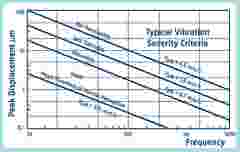
The actual level measured will be judged more or less severe by comparison with previously or subsequently measured levels or with published severity criteria. An example of the latter is shown in the drawing, extracted from standards and recommendations for judging the vibration severity of rotating machinery. (ISO 20816-1)
For diagnostic purposes, for example in the course of product development, frequency analysis is necessary. Some frequency components in the vibration frequency spectrum can be immediately related to particular forcing functions, for example, shaft rotation speeds, gear tooth meshing frequencies, etc.
We will almost always find additional significant frequency components in the spectrum which are also related to the fundamental motions. The most significant is usually harmonics (a multiple) of one of the fundamental frequencies. Harmonics often arise because of distortion of the fundamental frequencies or because the original periodic motion is not purely sinusoidal. If they coincide with the resonant frequencies of other machine elements, then possibly considerable vibration levels can result, which can become a major noise source or result in the transmission of high forces to other machine parts.
With gear wheels, tooth form deflection under load and tooth wear will give rise to a tooth meshing frequency component and harmonics.
Furthermore, sideband components are often generated around the tooth meshing frequency and harmonics, due to periodic variations such as eccentricity. The first upper and lower sidebands will appear at the tooth mesh frequency (ft) plus and minus the gear rotation frequency (fg), the second sidebands at ft ± 2fg, and so on. Around the tooth mesh harmonics, a similar pattern may be present (i.e. 2ft ±fg, etc.)
It is often impracticable to alter forcing frequencies (shaft speeds, gear ratios, etc.) so other methods of reducing undesirable vibration levels are used. For example. detuning the machine element (altering its resonant frequency) by changing its mass or stiffness; by attenuating the transmission of vibration with isolation materials, or by adding damping materials to reduce the vibration amplitude.