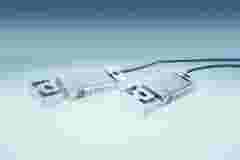
In this interview, we speak with Thomas Kleckers, Product Manager at HBK, about the latest advancements in strain transducers and their benefits over traditional force transducers in industrial applications.
With years of experience in force measurement technology, Thomas shares valuable insights into the design and functionality of HBK’s strain sensors, such as the SLH700. He explains how these innovations are transforming critical sectors like structural monitoring and heavy load measurement. Through his expertise, we gain a deeper understanding of how these technologies can enhance accuracy, simplify installations, and reduce costs in demanding industrial environments.
What is the operating principle of strain transducers?
Strain transducers work by detecting the deformation of an object under an applied force. At HBK, we offer two main technologies: CSW piezoelectric strain sensors and SLH strain gauge sensors.
The SLH sensors, in particular, use a full-bridge strain gauge circuit, which allows them to be compatible with a wide range of standard bridge amplifiers, making integration into existing systems very simple and flexible. Designed with ease of installation and durability in mind, the SLH sensor is made from stainless steel, providing excellent corrosion resistance and suitability for harsh industrial environments. Additionally, it is hermetically sealed, offering optimal protection for the strain gauges against moisture and contaminants, achieving an IP68 protection rating. This level of protection is critical for environments where sensors are exposed to extreme conditions such as dust, water, or significant temperature fluctuations.
Finally, the spring body design minimises force shunting, ensuring highly accurate measurements with double the sensitivity of traditional bonded strain gauges. This allows the capture of very low forces or subtle variations with suitable precision. Amplified versions, with current or voltage outputs, further simplify the measurement process, reducing the cost of additional equipment.
In which scenarios would you suggest using strain transducers instead of force transducers?
Strain transducers are particularly well-suited for applications where very high forces or weights need to be measured, often in challenging environments. For instance, they are indispensable when measuring press forces in the meganewton range. Their robustness and resistance to extreme conditions make them ideal for outdoor installations, such as measuring weights on silos. Strain transducers excel in harsh industrial environments, providing reliable measurements even in complex configurations. They are especially practical in situations where integrating a load cell into the machine design is difficult or impossible. Installation is straightforward, requiring only that the transducer be screwed onto a suitable surface, allowing for quick implementation without major infrastructure modifications. Calibration after installation is necessary if quantitative measurements are required.