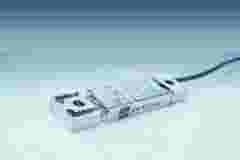
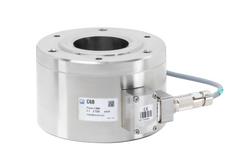
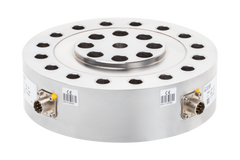
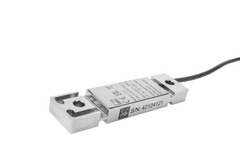
In case of pure tensile or compressive strain, both sensors in the example above measure the same strain in the same direction. If bending occurs, one element measures positive strain while the other element measures negative strain. This results in a zero output, achieving bending moment compensation.
It is also possible to use four sensors from the SLH series and connect them in parallel. However, a parallel setup is much easier with non-amplified extensometers and an external amplifier. The passive SLH are designed for this measurement situation: their high input resistance of 1000 Ohms allows for the connection of four or more sensors in parallel without issues related to low sensor impedance with standard market instruments. Additionally, the sensors are adjusted for the relationship between output resistance and rated output, which is important for parallel setups.
Teach-in procedure with amplifier extensometers of the SLH series
Many available strain transducers with an integrated amplifier module only have a fixed amplification. For example, 500 µm/m corresponds to an output signal of 10 V. The fundamental drawback of this method is that the maximum output signal depends upon the given amplification, which cannot be changed. If, a strain of 200 µm/m is used as the input signal, the resulting output voltage is 4 V. This can lead to unsatisfactory results, if the next element in the measurement chain is a module that has a low resolution or increased noise.
SLH700VA strain links with integrated amplifier electronics overcome this problem by providing the maximum possible output signal at all times, regardless of the intended purpose.
The teach-in procedure is simple:
- Install the sensor as usual and reduce the load on the machine (press, roll stand, silo) to zero. Send a longer pulse to the teach-in input to allow the electronics to memorise the zero point
- Apply the calibration load and send a short pulse to the teach-in input. This adjusts the electronics between the zero point and the calibration load
- This process ensures that the input range of the next level is fully utilised at all times
- The teach-in procedure can be performed at 25%, 50%, or 100% of the full scale
Additional advantages of this procedure:
- There is always a 10% buffer in the upper and lower parts of the measuring range. Higher strain signals, such as those occurring during a failure, failure) are still amplified and transmitted
- The characteristic curve can be negative, allowing both elongation and shortening to be converted into a positive signal
- The built-in measuring amplifier provides low noise and a bandwidth of 2 kHz
- It is essential to permanently store the span, which is the difference between the minimum and maximum values. Therefore, resetting to zero after a power failure is imperative
Why choose SLH extensometers?
SLH sensors offer a cost effective and reliable alternative to load cells for press force measurement with load cells. Here are some key benefits:
- With an IP68 protection rating, the sensors and cables are resistant to most oils and water, and can be used on drag chains All materials are rust free, ensuring reliable measurements in harsh industrial environments
- The low force shunt means that the sensor’s influence on the press is negligible.
- Mounting requires just two screws and no special tools
- Users can choose between amplified and passive versions depending on the measurement situation. Both models have the same outer dimensions, allowing for easy exchange
- The amplified version supports partial teach-in functionality, making it suitable for situations where applying the full range force is not possible, such as in dynamic presses