


Der ML5-AR IMU/Neigungssensor ermöglicht kostengünstige und präzise Messungen von dynamischer Neigung, Beschleunigung und Winkelgeschwindigkeit in anspruchsvollen Umgebungen und wurde speziell für die Anforderungen der Schwerlastbau-, Offroad-, Landwirtschafts-, Bergbau- und Transportindustrie entwickelt.
Das ML5-AR nutzt die Leistungsfähigkeit eines hochentwickelten , selbstadaptiver erweiterter Kalman-Filter (EKF), um Fehler im Zusammenhang mit Vibrationen, plötzlichen linearen Bewegungen und Erdbeben zu beseitigen und so unter allen Bedingungen eine präzise Neigungsmessung zu gewährleisten.
Modernste Temperaturkompensation und Kalibrierung gewährleisten einen fehlerfreien Betrieb über den gesamten Betriebstemperaturbereich.
Die kompakte Größe, der breite Spannungsbereich von 4,5 bis 36 V, die Schutzart IP68/IP69K und die CAN-Kommunikationsschnittstelle machen den ML5-AR zu einer Komplettlösung für eine Vielzahl von Fahrzeuggrößen und Anwendungen.
Dieses Produkt wird für neue Konstruktionen nicht empfohlen. Die aktualisierte Version finden Sie hier.

ML5-AR
| Document | Typ | Sprache |
|---|---|---|
| ML5-AR - Data Sheet | Datenblätter | English |
| M-Series - Quick Start Guide | Kurzanleitung | English |
| M-Series Development Kit | Accessory Guide | English |
| M-Series Cable Kit (Japan) | Accessory Guide | English |
| M-Series Cable Kit | Accessory Guide | English |
| M-Series Development Kit (Japan) | Accessory Guide | English |
| M-Series - User Manual CAN J1939 | Handbuch/Bedienungsanleitung | English |
| M-Series - User Manual CANopen | Handbuch/Bedienungsanleitung | English |
| Inertial Sensing Solutions for Off-Highway Applications | Broschüre | English |
| CAN to Serial Cable ICD | Technische Zeichnung | English |
Sales documents
| Document | Typ | Sprache |
|---|---|---|
| Zeta Racing - Case Study | Anwendungsbeispiel | English |
Certificates and Approvals
| Document | Typ | Sprache |
|---|---|---|
| ML5-AR Declaration of Conformity (EU) | Konformitätserklärung | English |
| ML5-AR Declaration of Conformity (UK) | Konformitätserklärung | English |
| Document | Typ |
|---|---|
| M-Series CAD Model | CAD-Dateien (STEP) |
| M-Series SAE J1939 Configuration File | Software |
| Eigenschaft | Wert |
|---|---|
| Type | Inertial (IMU) |
| Performance Grade | Industrial Grade |
| Random Walk | Accel: 120 µg/√Hz, Gyro: 0.45 °/√hr |
| Bias Instability (Gyroscope) | 8 °/hr |
| Bias Instability (Accelerometer) | 80 μg |
| Hysteresis | Accel bias: 16 mg, Accel gain: 1000 PPM, Gyro bias: 1.0 °/s, Gyro gain: 1000 PPM |
| Communication Port Type | AMPSEAL 16 gold plated 4 pin |
| Communication Interface | CANopen |
| Update Rate | IMU: 500Hz, EKF: 500Hz |
| Weight | 110.5 g |
| Weight | 38.98 oz |
| Size | 78.9 mm x 55 mm x 23.5 mm |
| Size | 3.11 in x 2.17 in x 0.93 in |
| Power Consumption | 0.625 W |
| Input Voltage | 4.5 V to 36 V, 12/24 Nominal |
| Minimum Operating Temperature | -40 °C |
| Maximum Operating Temperature | 85 °C |
| Minimum Operating Temperature | -40 °F |
| Maximum Operating Temperature | 185 °F |
| MTBF | 826440 h |
| Sensing Range (Accelerometer) | 20 g |
| Sensing Range (Gyroscope) | 1000 °/s |
| Accuracy | Roll/Pitch (static): 0.25 ° |
| Ingress Protection Rating | IP68, IP69K |
| Housing Material | Fiber-Reinforced PBT |
| Mounting Style | Screw Down |
List of accessories available for all variants of this family
| Product Code | Beschreibung |
|---|---|
 6212-3016
|
IMPACT SHIELD,MV5 |
 6212-3017
|
CABLE KIT,CAN, M-SERIES |
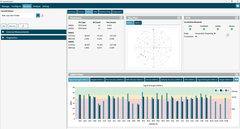
InertialConnect is the latest software solution for MicroStrain inertial sensors. With InertialConnect, you can easily configure your sensors, adjust parameters, upgrade firmware, and deploy preconfigured parameter files. You can also verify sensor outputs with intuitive visualizations, including times eries data, position data, and statuses.
InertialConnect is compatible with both PC desktop and Linux operating systems, making it your go-to solution for precision and efficiency in inertial sensor management.

SensorConnect is the next generation in desktop sensing software.
From configuration of nodes and starting networks, to collecting and analyzing data in real-time, SensorConnect provides a modern, powerful experience with our Wireless, Inertial, and Displacement products.
Using our intelligent data collection and graphing algorithms, you are able to visualize massive amounts of data instantly, and then zoom in on points of interest just as fast.
Built in MathEngine functionality allows for both real-time and post-processed math, such as generating FFTs, averages, RMS, etc.
SensorCloud is a unique sensor data storage, visualization, and remote management platform that leverages powerful Cloud computing technologies to provide excellent data scalability, rapid visualization, and user programmable analysis.
MicroStrain sensors can instantly upload their data to SensorCloud via an ethernet-connected WSDA-2000. Once uploaded, your data is securely stored in the Cloud and can be accessed from anywhere, or downloaded for offline use.
Configurable alerts can be set to help notify you of real-time event in your data.
MathEngine allows you to perform analytics on your data, all in the Cloud. Pre-built functions are available for ease of use, while IPython Notebooks allow advanced users to write custom scripts to be run on their data once, or on a schedule.
The MicroStrain Communication Library (MSCL) is our open-sourced API that simplifies writing code to interact with our sensors. MIP SDK is a lightweight C/C++ library for interacting with MicroStrain G and C-series products via baremetal and resource constrained microcontrollers.
Both APIs are readily available and fully-documented on GitHub, featuring valuable tools such as full documentation, example code, and a quick start guide.


Dies vereint die Marken HBM, Brüel & Kjær, nCode, ReliaSoft und Discom und ermöglicht es Ihnen, schneller Innovationen für eine sauberere, gesündere und produktivere Welt zu schaffen.

Dies vereint die Marken HBM, Brüel & Kjær, nCode, ReliaSoft und Discom und ermöglicht es Ihnen, schneller Innovationen für eine sauberere, gesündere und produktivere Welt zu schaffen.

Dies vereint die Marken HBM, Brüel & Kjær, nCode, ReliaSoft und Discom und ermöglicht es Ihnen, schneller Innovationen für eine sauberere, gesündere und produktivere Welt zu schaffen.

Dies vereint die Marken HBM, Brüel & Kjær, nCode, ReliaSoft und Discom und ermöglicht es Ihnen, schneller Innovationen für eine sauberere, gesündere und produktivere Welt zu schaffen.

Dies vereint die Marken HBM, Brüel & Kjær, nCode, ReliaSoft und Discom und ermöglicht es Ihnen, schneller Innovationen für eine sauberere, gesündere und produktivere Welt zu schaffen.