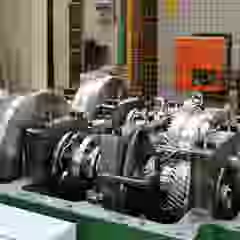
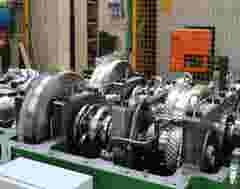
Easing the workload for system integrators
BCSA has positioned itself as a flexible, innovative company with a focus mainly on exports - a segment in which BCSA excels with up to 80% of turnover attributed to exports. The technical development of the BCSA transmission system has far surpassed standard specifications to stay ahead of the competition and most importantly - to ease the workload of the customer.
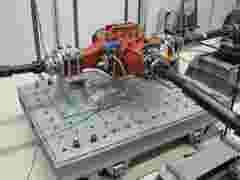
It is important to remember that power test benches (e.g. for airplane or race car motors) require a physical simulation of real conditions and of the actual loads a motor will be subjected to in order to correctly test the motor during its acceleration and deceleration processes.
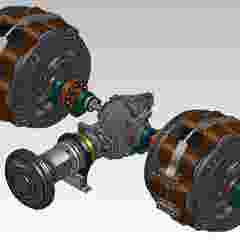
Loads are generally simulated using an electric motor in generator and/or brake mode. In most cases, a mechanical transmission is implemented between the motor (running at a very high speed) and the load running at a lower speed.
The test benches are equipped with test and measurement equipment including at least one torque sensor to measure motor performance. The torque sensor will usually be positioned at the side that rotates at high speed, located between the turbo transmission and the test specimen.
David Montillet, Managing Director of BCSA, offers some insights: "Usually, the test bench integrator will implement the integration of the torque transducer in the drive train at the input of the transmission.
A prerequisite is that two additional mechanical couplings plus a torque flange have to be installed in the shaft. That means that a lot more space is needed. Aligning the shafts requires specific expertise, otherwise vibrations and mechanical loads might develop which could result in damage to the test bench. In our case, there is another challenge to overcome: rotational speed! At high rotational speeds, adding mechanical masses and components will increase the risk of vibrations which, in the worst case, may result in destruction of the test bench.
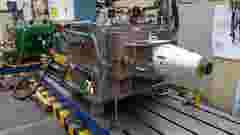
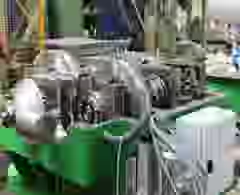
Our customer was well aware of these issues, which is why our ready-to-use solution with its turbo transmission-integrated torque sensor closed the deal ..."
"Promising strategy for the future"
"When BCSA contacted us, we had not yet developed a sensor matching their requirements but we were very interested as the demand in the market is very high. In my experience, the integration of test benches focuses mainly on monitoring and all the electronics involved, while the mechanical portion is left out. The higher the rotational speeds tested, the more the integration becomes a task for specialists. BCSA's suggestion to integrate the 1 kNm T40HS torque sensor inside the transmission offers a very promising strategy for the future", explains Nicolas Di Pol. This implementation is particularly suited to high speeds and HBK feels that it will increase the demand for high rotational speed torque sensors, specifically for airplane engine test benches. Motors run with ever increasing speeds to reduce weight - and therefore fuel consumption.