
When you need to measure strain on an object, you are often doing so in a short timeframe. If the strain gauge is improperly installed, you can receive false measurements, which may cause you to spend even more time correcting these mistakes.
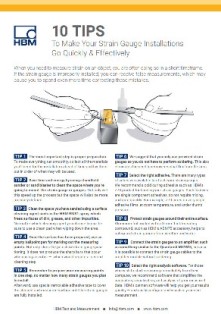
Tip 6: We suggest that you only use pre-wired strain gauges so you do not have to perform soldering. This also eliminates the need to remove residual flux from the area.
Tip 7: Select the right adhesive. There are many types of adhesives available to attach your strain gauges. We highly recommend a cold curing adhesive such as HBM’s Z70 product for bonding your strain gauges. Such fixatives are single component adhesives, do not require mixing, and cure quickly. For example, Z70 cures on very slight adhesive films, at room temperature, and under thumb pressure.
Tip 8: Protect strain gauges around their entire surface. Aluminum foil coated with a 3-mm thick kneading compound, such as HBM’s ABM75 accessory, helps to safeguard strain gauges from weather and water.
Tip 9: Connect the strain gauges to an amplifier, such as something similar to the QuantumX MX1615B, because it is possible to connect the strain gauge cables to the amplifier module without soldering.
Tip 10: Select the right analysis software. For those who wish to start measuring immediately from their computer, we recommend software that simplifies the acquisition, visualization, and analysis of your measured data. HBM’s catman software will help you get your results quickly — and easily configure and visualize your next measurement.