By detecting vibratory acceleration, we are not tied to that parameter alone. We can convert the acceleration signal to velocity and displacement. Most modern vibration meters are equipped to measure all three parameters.
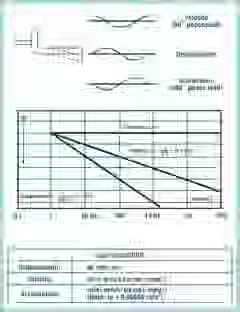
Where a single, wide-frequency band vibration measurement is made, the choice of parameter is important if the signal has components at many frequencies. Measurement of displacement will give the low-frequency components the most weight, and conversely, acceleration measurements will weigh the level towards the high-frequency components.
Experience has shown that the overall RMS value of vibration velocity measured over the range of 10 to 1000 Hz gives the best indication of a vibration's severity on rotating machines. A probable explanation is that a given velocity level corresponds to a given energy level; vibration at low and high frequencies are weighted equally from a vibration energy point of view. In practice, many machines have a reasonably flat velocity spectrum.
Performing narrow-band frequency analysis, the choice of the parameter will be reflected only in the way the analysis is tilted on the display or print (as demonstrated in the middle diagram above). This leads us to a practical consideration that can influence the choice of parameter. It is advantageous to select the parameter which gives the flattest frequency spectrum to best utilize the dynamic range (the difference between the smallest and largest values that can be measured) of the instrumentation. For this reason, the velocity or acceleration parameter is normally selected for frequency analysis purposes.
Because acceleration measurements are weighted towards high-frequency vibration components, these parameters tend to be used where the frequency range of interest covers high frequencies.
The nature of mechanical systems is such that appreciable displacements only occur at low frequencies; therefore, displacement measurements are of limited value in the general study of mechanical vibration. Where small clearances between machine elements are being considered, vibratory displacement is of course an important consideration. Displacement is often used as an indicator of unbalance in rotating machine parts because relatively large displacements usually occur at the shaft rotational frequency, which is also the frequency of greatest interest for balancing purposes.