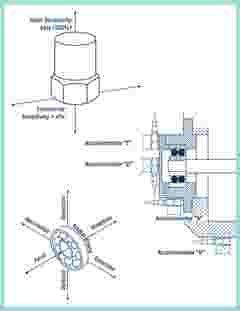
The accelerometer should be mounted so that the desired measuring direction coincides with its main sensitivity axis. Accelerometers are also slightly sensitive to vibrations in the transverse direction, but this can normally be ignored as the transverse sensitivity is typically less than 5% of the main axis sensitivity.
The reason for measuring vibration on the object will usually dictate the position of the measuring point. Take the bearing housing in the drawing as an example. Here, acceleration measurements are being used to monitor the running condition of the shaft and bearing. The accelerometer should be positioned to maintain a direct path for the vibration from the bearing.
Accelerometer "A" thus detects the vibration signal from the bearing predominant over vibrations from other parts of the machine, but accelerometer "B" detects the bearing vibration, probably modified by transmission through a joint, mixed with signals from other parts of the machine. Likewise, accelerometer "C" is positioned in a more direct path than accelerometer "D".
The question also arises — in which direction should one measure on the machine element in question? It is impossible to state a general rule, but as an example, for the bearing shown, one could gain valuable information for monitoring purposes by measuring both in the axial direction and one of the radial directions, usually, the one expected to have the lowest stiffness.
The response of mechanical objects to forced vibrations is a complex phenomenon so that one can expect, especially at high frequencies, to measure significantly different vibration levels and frequency spectra, even on adjacent measuring points on the same machine element.