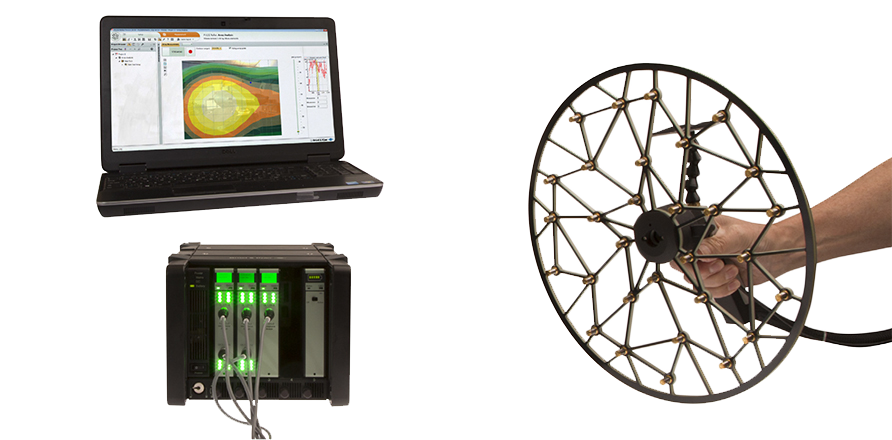
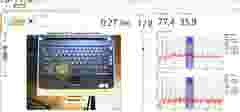
When a particular region has to be investigated in detail, the plate can be removed and the array positioned at 5cm (the average spacing between the microphones) from the device under test.
At such a close distance the array microphones can detect all the amplitudes and phase information of both the propagating and the evanescent sound waves which enables a complete description of the sound field to be calculated; this is the holography technique.
The useful frequency ranges of these techniques do not cover the complete frequency range of interest of the noise engineer; the resolution of beamforming is related to the wavelength of sound and is, therefore, most useful at high frequencies whilst holography can be used at low frequencies, its resolution is set by the distance between the microphones.
However, for stationary noise, there is a solution called Wideband Holography. With Wideband Holography the data is measured with the array at 10cm from the device under test (twice the average spacing between the microphones) which is in between the ideal position for holography and for beamforming. The data is then transferred to the Array Acoustics Post-processing application which contains the WBH calculation. This patented algorithm provides excellent estimates of sound power levels at both low and high frequencies.