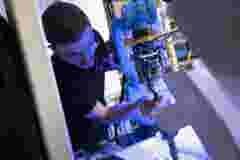




PW22i
Enhanced with smart IO-Link technology, the PW22i single-point load cell is engineered for high-speed dynamic processes requiring high stiffness and seamless automation.
Read More

Robots can execute movements with exceptional precision. But precision alone does not guarantee that a product has been correctly gripped.
As robotic automation becomes faster and more flexible, manufacturers increasingly require real-time feedback from the point of contact itself. By embedding intelligent load measurement directly into the gripper, it becomes possible to validate every grip, improve process reliability, and make better decisions in real time.
This is the challenge HBK and Siléane set out to solve together.
Modern robots can position, move, and handle products with remarkable accuracy. Yet even the most advanced robotic systems often lack direct visibility into one critical parameter: grip quality.
For Siléane, this challenge emerged while developing a robotic gripping system for a leading cosmetics manufacturer. The application required the reliable handling of lightweight thermoformed trays throughout the packaging process – from depalletising to machine loading.
While the robot could execute every movement with precision, there was no direct way to verify that the tray was correctly gripped at every contact point.
A partial grip, uneven load distribution, or tray deformation could remain undetected until it affected product quality or process stability.
The challenge was not just moving the tray.
It was proving in real time that it was securely and correctly gripped before the next operation began.
Rather than developing a completely new sensing technology, Siléane wanted to leverage a solution already proven in industrial environments.
The PW22 load cell quickly emerged as the ideal foundation.
Widely used in packaging and dynamic weighing applications, the PW22 is known for its high accuracy, excellent repeatability, fast settling time, and ability to compensate for off-centre loads – critical characteristics for robotic gripping applications.
However, Siléane needed more than measurement performance.
They needed a sensor capable of integrating seamlessly into a modern automation architecture.
Working closely with Siléane, HBK transformed the proven PW22 into the PW22i – an intelligent load cell combining the metrological performance of the original sensor with integrated IO-Link communication, embedded digital electronics, and real-time diagnostics.
The result was not simply a connected sensor.
It was a new sensing layer capable of bringing measurement, diagnostics, and decision-ready data directly into the robotic system.
“This project reflects a fundamental shift in automation: embedding intelligence at the sensor level, to build systems that are more reliable, more autonomous, and easier to deploy.”
By integrating four PW22i load cells directly into each robotic gripper, Siléane transformed gripping from an assumed operation into a measurable and controllable process.
Each sensor continuously monitors the forces applied at its contact point, enabling the system to validate grip quality in real time and immediately detect any imbalance or anomaly.
Beyond improving process reliability, the IO-Link architecture simplified integration through reduced wiring, faster commissioning, and direct access to sensor diagnostics.
The project demonstrates how proven measurement technology can evolve to meet the requirements of modern automation – without compromising reliability, simplicity, or performance.
Key Benefits:
Discover how HBK and Siléane combined proven load cell technology with smart IO-Link connectivity to create a reliable, scalable sensing solution for robotic gripping applications.
Download the complete case study to explore the full system architecture, technical implementation, and engineering insights behind the project.

This will bring together HBM, Brüel & Kjær, nCode, ReliaSoft, MicroStrain and Discom brands, helping you innovate faster for a cleaner, healthier, and more productive world.
