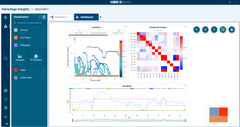
Engineering teams today are working with larger sensor datasets than ever before. Whether analyzing IoT monitoring streams, validating digital twins, or supporting predictive maintenance strategies, the challenge is often the same: there’s simply too much time-series data to process efficiently.
That’s why the latest Time Series Compression capability in Advantage Insights is designed to help engineers reduce dataset size while preserving the information that matters most.
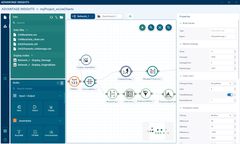
In addition to the existing ways to reduce the amount of time series data (i.e. select specific channels or select specific sections in time), users can now use the new Time Series Compression node.
Time Series Compression is a new capability in Advantage Insights that reduces the size of large sensor datasets without losing their essential characteristics.
Instead of manually trimming signals or removing channels prematurely, engineers can now automatically compress time-series data to make it faster to process, easier to visualize, and more practical to work with across complex workflows.
This makes it easier to move from raw data to insight - without sacrificing confidence in results.

Time Series Compression reduces the number of data points in a signal while preserving its key trends, transitions, and relationships with other signals.
This is particularly useful when working with:
Importantly, compression maintains synchronization between signals, ensuring datasets remain suitable for downstream engineering analysis.
The result is smaller datasets that still reflect the behavior engineers need to understand.
The Time Series Compression node intelligently identifies which points in a signal are essential for preserving its shape and removes those that contribute little additional information.
Rather than simply down sampling data uniformly, it:
Once compressed, signals become significantly faster to process, transfer, and visualize - especially when working across large-scale datasets.
Engineers are often working with signals recorded over long periods of time or across many sensors, and that can make analysis slow and difficult to manage. Time Series Compression helps reduce that data volume while keeping the important signal characteristics intact, so users can focus on extracting insight rather than handling data.
By combining Time Series Compression with channel filtering, and section extraction, engineers can quickly transform complex datasets into manageable working sets.
This makes it easier to:
Used alongside physics-based indicators and calculated channels, compression helps streamline the path from raw measurements to actionable insight. 🚀
This will bring together HBM, Brüel & Kjær, nCode, ReliaSoft, and Discom brands, helping you innovate faster for a cleaner, healthier, and more productive world.
This will bring together HBM, Brüel & Kjær, nCode, ReliaSoft, MicroStrain and Discom brands, helping you innovate faster for a cleaner, healthier, and more productive world.