

arrow_back_ios

Main Menu

arrow_back_ios

Main Menu

arrow_back_ios

Main Menu

What does a multi-axis sensor measure?

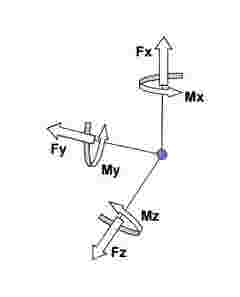
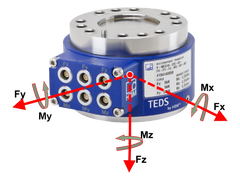
Multi-axis sensors such as the MCS10 form HBK feature up to six measurement circuits:

Forces

  • Fx – force along the x-axis
  • Fy – force along the y-axis
  • Fz – force along the z-axis


Torque (bending moments)

  • Mx – torque around the x-axis
  • My – torque around the y-axis
  • Mz – torque around the z-axis
multi-component
multi axis sensor article

An MCS10 multi-axis sensor is also very compact, allowing it to replace the measurement tasks of six individual sensors with a single unit.

Where is a multi-axis sensor used?

You can find a multi-axis sensor in many different applications – whenever a uniaxial sensor does not provide enough information. Six-axis sensors are used in robotors and cobots, enabling them to handle workpieces with the appropriate force or torque. They are also used in wind tunnels, where the sensors can measure lift forces, the impact of side winds, and other aerodynamic effects with a single device.

MCS10 sensors support assembly lines as well, for example when components are sensitive to overloads or when collision detection is required. They are also widely used in component testing and various experimental setups that rely on precise multi-axis measurement data.

How does a multi-axis sensor work?

A multi axis sensor consists of a so-called spring body (or spring element) made from titanium, steel or sometimes aluminium. When a force or a torque is applied to this element, mechanical strain develops on its surface. Strain gauges are bonded to carefully selected locations on the spring element, where they detect this strain by converting it into a change in electrical resistance.

These strain gauges are connected to form a bridge circuit. When the bridge is supplied with an external excitation voltage, it produces an output signal that  is linearly related to the strain under the gauges – and therefore directly proportional to the applied  force or torque.

A six-axis sensor contains six galvanically isolated bridge circuits, with each circuit dedicated to one specific component of force or torque. This allows the sensor to measure all six degrees of freedom simultaneously and independently.

What is crosstalk?

If a force or a torque is applied precisely in one direction of a force/torque sensor, you would ideally expect an output signal only from the corresponding bridge circuit. In reality, a very small signal appears on the other channels as well.

For example, if you apply a force in the z-direction, you will still measure a small output on the Fy, Fx, Mx, and Mz bridges.

Crosstalk occurs because spring elements have manufacturing tolerances, and the sensitivity of strain gauges also varies slightly.

How can I calculate the maximum crosstalk effect?

Crosstalk is specified in the datasheet as a percentage relative to the full-scale value of the affected axis.

Example:

You are using an MCS10-050. The datasheet provides the following information:

  • Nominal Force in z-direction (Fz) = 50 kN
  • Nominal Force in x -direction (Fx) = 10 kN
  • Maximum crosstalk of forces introduced in x–direction onto the z-output: 0.5%

Question:

What is the maximum uncertainty on the Fz output when a force of 5 kN is applied in the x-direction?

If Fx is loaded to its maximum (10 kN), the maximum crosstalk effect on the Fz output is:

0.5% of 50, 000 N = 250 N


In our example, since only 5 kN (half of the nominal 10 kN) is applied, the uncertainty can be calculated as follows:

250 N * 5 kN/10 kN = 125 N

Related Content