MAIN MENU

Find the Right Inertial Sensor for Your Application

Inertial sensors are powerful devices that use accelerometers and gyroscopes to measure and report an object's motion. From simple tilt sensing to full-scale autonomous navigation, inertial sensors provide the critical data needed to control movement and orientation in space. MicroStrain inertial sensors are built using Micro-Electro-Mechanical Systems (MEMS) technology and are widely used in advanced motion systems, including robotics and autonomous systems.


The term Inertial Measurement Unit (IMU) is widely used throughout the industry. It can refer generally to any inertial sensor, but it also defines a specific product class. A foundational IMU provides raw, fundamental motion data. In contrast, more advanced systems – such as a Vertical Reference Unit (VRU), Attitude and Heading Reference System (AHRS), or Inertial Navigation System (INS) – integrate additional sensors and sophisticated filtering for complete orientation and navigation solutions. These systems are also used as inertial sensors for GNSS-denied navigation, helping maintain robust motion and position accuracy even when satellite signals are limited or unavailable.

To help you find the right fit for your project, we have broken down our product types below. Each product type builds on the last, guiding you from the core sensor to a complete navigation solution.

1. IMU: The Core Motion Sensor

An Inertial Measurement Unit (IMU) is the foundational sensor for understanding motion. It provides the essential raw data about an object's movement without external references.

  • What it measures: Acceleration and angular rate (how fast something is moving and rotating).
  • Key purpose: Provides the fundamental data for tracking and controlling motion.
  • Ideal for: Applications where you have your own advanced algorithms or only need raw sensor data, such as custom control systems or research.

2. VRU: Adding Vertical Reference

Vertical Reference Unit (VRU) builds upon the IMU by adding sophisticated internal filtering. The filter, MicroStrain's Auto-Adaptive Extended Kalman Filter (EKF), computes a stable orientation relative to the Earth’s gravity.

  • What it adds: A reliable Pitch and Roll (tilt) measurement.
  • Key purpose: Provides a stable "level" reference for objects.
  • Ideal for: Platform stabilization, robotics, antenna pointing, and systems needing precise vertical alignment.

3. AHRS: Full Orientation with Heading

An Attitude and Heading Reference System (AHRS) advances the VRU by incorporating a magnetometer. This allows for a complete, stable 3D orientation, including heading.

  • What it adds: A stable Yaw (heading) measurement, along with Pitch and Roll.
  • Key purpose: Provides a comprehensive understanding of an object's spatial orientation, including its direction.
  • Ideal for: Drone navigation, camera stabilization, personal tracking, and any application requiring a full 3D attitude solution.

4. INS: Global Navigation Solution

An Inertial Navigation System (INS) expands an AHRS to provide a complete navigation solution that includes position and velocity, in addition to attitude and heading. In some cases, an INS model integrates a Global Navigation Satellite System (GNSS) receiver to provide a full position, velocity, and time (PVT) solution.

  • What it adds: Precise global position (latitude, longitude, altitude) and velocity.
  • Key purpose: Offers a complete navigation solution for dynamic platforms.
  • Ideal for: Autonomous vehicles, surveying, mapping, hydrography, and applications requiring highly accurate position and orientation in real-time.

Testado e comprovado por inovadores líderes em todo o mundo

Software

chevron_left
chevron_right
image

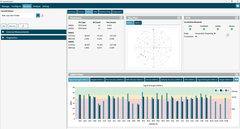
InertialConnect is the latest software solution for MicroStrain inertial sensors. With InertialConnect, you can easily configure your sensors, adjust parameters, upgrade firmware, and deploy preconfigured parameter files. You can also verify sensor outputs with intuitive visualizations, including times eries data, position data, and statuses.

InertialConnect is compatible with both PC desktop and Linux operating systems, making it your go-to solution for precision and efficiency in inertial sensor management.

image

SensorConnect is the next generation in desktop sensing software.

From configuration of nodes and starting networks, to collecting and analyzing data in real-time, SensorConnect provides a modern, powerful experience with our Wireless, Inertial, and Displacement products.

Using our intelligent data collection and graphing algorithms, you are able to visualize massive amounts of data instantly, and then zoom in on points of interest just as fast.

Built in MathEngine functionality allows for both real-time and post-processed math, such as generating FFTs, averages, RMS, etc.

image

SensorCloud is a unique sensor data storage, visualization, and remote management platform that leverages powerful Cloud computing technologies to provide excellent data scalability, rapid visualization, and user programmable analysis.

MicroStrain sensors can instantly upload their data to SensorCloud via an ethernet-connected WSDA-2000. Once uploaded, your data is securely stored in the Cloud and can be accessed from anywhere, or downloaded for offline use.

Configurable alerts can be set to help notify you of real-time event in your data.

MathEngine allows you to perform analytics on your data, all in the Cloud. Pre-built functions are available for ease of use, while IPython Notebooks allow advanced users to write custom scripts to be run on their data once, or on a schedule.

image

SensorCloud RTK is a multi-continent, IP-based RTK cloud network that delivers centimeter-level position accuracy from day one without complex setup, featuring network coverage across the U.S., Europe and beyond.

When paired with compatible MicroStrain navigation systems, it offers seamless scalability from development to production with professional technical support throughout.

image

The MicroStrain Communication Library (MSCL) is our open-sourced API that simplifies writing code to interact with our sensors. MIP SDK is a lightweight C/C++ library for interacting with MicroStrain G and C-series products via baremetal and resource constrained microcontrollers.

Both APIs are readily available and fully-documented on GitHub, featuring valuable tools such as full documentation, example code, and a quick start guide.


Built for ROS

Robot Operating System (ROS) is an open-source, meta-operating system for your robot. It provides the services you would expect from an operating system, including hardware abstraction, low-level device control, implementation of commonly-used functionality, message-passing between processes, and package management. ROS can be used in building and simulating robotics applications, as well as unmanned ground vehicles and simultaneous localization and mapping (SLAM). MicroStrain has an open source License free (MIT License) series of drivers specifically designed and tested for ROS.

image