



arrow_back_ios

Main Menu

arrow_back_ios

Main Menu

arrow_back_ios

Main Menu

In today's competitive industrial landscape, maximising efficiency and future-proofing operations are paramount. IO-Link, a global standard enabling communication between PLCs and sensors/actuators, is at the forefront of this evolution.

Supported by leading technology companies, IO-Link now extends to HBK sensors for the digital measurement of mechanical quantities like force, load, and torque , offering a clear path to optimised operations and the lowest total cost of ownership (TCO).

What is IO-Link?

IO-Link is a global industrial communications standard (IEC 61131-9) that connects digital sensors and actuators to control systems like PLCs. As a bi-directional, point-to-point protocol, it simplifies connectivity, enhances data availability, enables detailed device diagnostics , and allows communication from the control level down to the sensors at the field level. As manufacturers embrace Industry 4.0, the need for more information from production processes is critical. HBK’s IO-Link solutions are ideally suited to meet these demands, helping you improve manufacturing efficiency and increase productivity.

IO-Link-quadratisch

Keep pace with technology while keeping costs low

Traditionally, using strain gauge sensors required purchasing an additional external amplifier. HBK’s IO-Link solutions eliminate this need by integrating the amplifier directly into the sensor or as an in-line component. This provides a single, cost-effective unit that simplifies your entire measurement chain.

Key benefits include:
  • Cost-effective, standardised cabling: IO-Link communicates at a robust 24 V level, removing the need for expensive shielded cables required by traditional analog sensors. Standardised IO-Link cables are over ten times cheaper, significantly reducing installation and material costs as they require only a single cable for both data transmission and power supply – unlike many other interfaces that use separate cables for data and voltage.
  • Space-saving solution: By integrating amplifiers and using decentralised IO-Link masters positioned near the sensors, our solution drastically reduces the need for valuable and expensive cabinet space.
  • Leverage existing infrastructure: If you have already adopted IO-Link, you can effortlessly incorporate HBK’s advanced sensors into your existing masters, further reducing system costs and complexity.
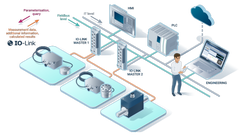
Infographic with typical setup of an IO-Link system in combination with force, load cell and torqu transducer.
IO-Link System Architecture -Force, Torque, Load

Why Digital Sensors Are the Future – Force, Torque & Load

Explore how IO-Link and digital sensors boost performance, cut downtime, and simplify integration. Don’t miss the tech shaping tomorrow’s automation.

Watch now and transform your processes.

Simplify interface management with IO-Link standardisation

Managing multiple interfaces is a common challenge in modern production environments. IO-Link provides a unified technology that accommodates approximately 90% of all sensors and actuators. This standardisation streamlines design, simplifies inventory, and reduces the need for specialised engineering expertise. As a widely accepted standard with a rapidly growing number of nodes, IO-Link offers investment security and a clear path away from the fragmented landscape of varied analog and digital signals.

Illustration of an infographic showing smart functions and features of smart sensors in isometric perspective

Intuitive commissioning and simplified service

Managing multiple interfaces is a common challenge in modern production environments. IO-Link provides a unified technology that accommodates approximately 90% of all sensors and actuators. This standardisation streamlines design, simplifies inventory, and reduces the need for specialised engineering expertise. As a widely accepted standard with a rapidly growing number of nodes, IO-Link offers investment security and a clear path away from the fragmented landscape of varied analog and digital signals.

Illustration of an infographic showing smart functions and features with smart sensors in isometric perspective

A new era in sensing mechanical quantities

HBK’s smart IO-Link sensors represent a new era in sensing mechanical quantities. They deliver measurement values directly in standard units (Newtons, kilograms, Newton-metres), with scaling information pre-stored in the sensor. This “plug and measure” capability eliminates the error-prone manual parameterisation of the past.

The benefits are clear:

  • Reduced training requirements: With pre-stored sensor data, streamlined parameterisation, and standardised M12 connectors, the need for specialised training in wiring, scaling, and signal output is significantly reduced.
  • Efficient maintenance: A standardised connection method for all sensors simplifies both commissioning and servicing, allowing technicians to work more efficiently and reduce overall service costs.
Illustration of an infographic showing smart functions and features of smart sensors in isometric perspective

Optimised workflow, reduced downtime, and greater accuracy

To prevent data overload, HBK’s IO-Link sensors use domain-specific algorithms to pre-process data, transmitting only essential results to your PLC. This simplifies processes and reduces costs.

Furthermore, our IO-Link sensors tackle critical industry challenges head-on:

  • Prevent downtime: Unlike analog sensors, they actively monitor health factors like temperature and load limits, providing early alerts that help prevent costly machine breakdowns.
  • Ensure accuracy and traceability: Calibration data is stored directly within the force and torque sensors, ensuring precise, reliable, and fully traceable measurements for quality assurance.
  • Improve precision: The combination of highly accurate amplifiers, advanced scaling options , optimised digital temperature compensation and embedded calibration data allows for significantly improved measurement accuracy across diverse applications.
IO-Link solutions II white-paper - mockup

Enhance your efficiency with strain gauge-based smart sensors empowered by IO-Link interface

Discover the full potential of our strain gauge-based smart sensors with the IO-Link interface in our white paper from HBK’s key experts.

Download now to gain invaluable insights into enhancing efficiency and precision in your operations!

The way forward: IO-Link and HBK

Investing in HBK sensors with IO-Link is a strategic move that delivers immediate cost savings and a high return on investment. By upgrading your processes while leveraging existing infrastructure and personnel, you can gain a significant competitive edge.

HBK is a trusted supplier offering a broad portfolio of IO-Link capable sensors, technical consulting, and world-class support. As industries evolve toward smarter manufacturing, our deep expertise in sensor solutions ensures you are making a secure, future-proof choice for your testing and measurement needs.

A future-proof investment in reliability

Investing in HBK sensors with IO-Link is more than just a modernisation step; it’s a strategic move that delivers a lower total cost of ownership (TCO) and a high return on investment (ROI). The reliability of your processes is enhanced through built-in sensor health monitoring, where the sensor continuously tracks its own mechanical and thermal loads and triggers an alert if pre-set limits are exceeded.

By upgrading to this technology, companies can achieve immediate cost savings on components and labour while building a more robust, intelligent, and flexible manufacturing environment. As industries continue their journey toward smarter manufacturing, HBK’s broad portfolio of IO-Link capable sensors and considerable expertise make them a trusted partner for creating the factories of the future.
Martin Schütz Product Manager Smart Sensors HBK

Support Content

close
Illustration of an infographic showing smart functions and features of smart sensors in isometric perspective