
Selecting Adhesives for Strain Gauge Installation
This article explains everything you need to know when it comes to selecting the adhesives for your Strain Gauge Installation.
Read More

Before the right strain gauge can be selected, the measurement goal needs to be clearly set. The main question to be considered is whether the strain gauge will be used for experimental tests, durability tests or for transducer manufacturing.
|
|
| Strain gauges for experimental tests | Strain gauges for transducer manufacturing |
The strain gauge selection for experimental test will be done regarding the following selection criteria:
| 1. Geometry: | Number and position of grids (pattern) |
|
2. Strain gauge series: | Construction of strain gauge |
| 3. Connections: | Type and position |
|
4. Temperature response adaptation: | Material to which strain gauge temperature response is matched |
| 5. Active grid length: | in mm |
| 6. Electrical resistance: | in Ohm |
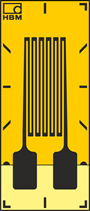 | Linear strain gauges (e.g. LY4) have one measuring grid and measure the strain in one direction. |
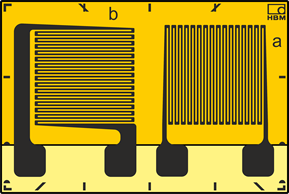 | T rosettes (e.g. XY3) have 2 measuring grids arranged at a 90° degree offset from each other. Typical applications for this strain gauge type include analysis of a biaxial stress state with known principal directions as well as measurements on tension and compression bars. |
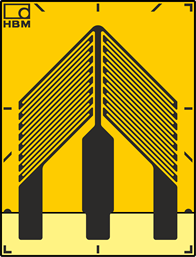 | V-shaped strain gauges (e.g. XY4) have 2 measuring grids arranged at a 90° degree offset from each other. Typical applications for these strain gauges include measurements on torsion bars and determining shear stresses as they occur in shear beams in the area of neutral fibers. |
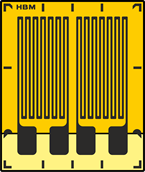 | Double linear strain gauges (e.g. DY4) have two measuring grids arranged parallel to each other. Typical applications for these strain gauges include measurements on bending beams. |
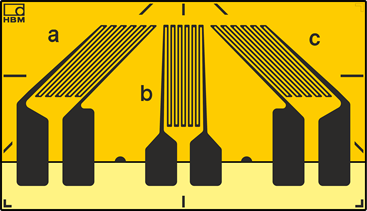 | Rosettes with 3 measuring grids (e.g. RY8) arranged at an angle of 0°/45°/90° or 0°/60°/120° are an appropriate choice for analyzing the biaxial stress state with unknown principal directions. |
 | Strain gauge chains (e.g. KY8) consist of 10 or 15 very small measuring grids that are placed on a common carrier at a constant spacing (equidistant apart) plus one compensation SG. Strain gauge chains are especially suitable for determining strain gradients. |
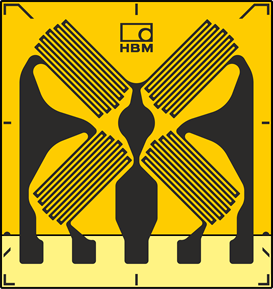 | Full bridge strain gauges (e.g. VY4) have 4 measuring grids, which are arranged so that each is offset to the next at an angle of 90°. Typical applications for full bridge strain gauges include measurements on tension/compression bars and determining shear stresses as they occur in shear beams. |

The quality of a measurement made with a strain gauge essentially depends on the type of installation and design of the measuring point. A thorough preparation of the installation surface, correct connection, and protective covering are important factors for problem-free results.
| |
Integrated solder tabs (e.g. LY4)
|
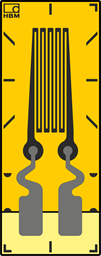 |
Big solder tabs with strain relief (e.g. LY6)
|
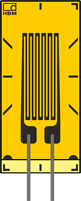 |
Ni-plated copper leads, uninsulated, approx. 30 mm (1.18 inch) long (e.g. LY1)
|
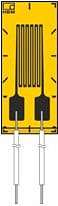 |
Fluoropolymer-insulated connection wires, approx. 50 mm (1.97 inch) long (e.g. K-C LY4)
|
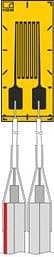 |
Fluoropolymer-insulated connection wires, approx. 50 mm (1.97 inch) long (e.g. K-C LY4)
|

Keep cool and get reliable measurement results with strain gauges even when the temperature changes. The article explains what you need to know!