
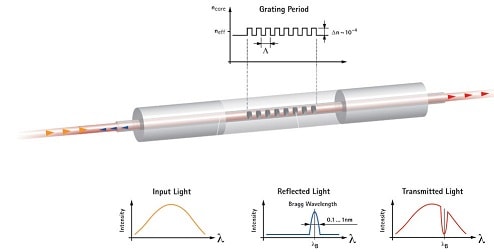

Optical fiber strain gauges that are based on fiber Bragg gratings (FBGs) operate on very different principles than those that govern traditional electrical strain gauges. In simplified terms, a fiber Bragg grating is a microstructure (typically a few millimeters long) created by modifying a standard single-mode telecom fiber, germanium-doped, with a UV laser. This microstructure creates a periodic variation in the refractive index of that optical fiber. As light travels along the fiber, the Bragg grating reflects a very narrow range of wavelengths; all of the other wavelengths are transmitted through the grating.
The center of this band of reflected wavelengths is known as the Bragg wavelength (Figures 1 and 2). Under stress, the period of an FBG increases due to the physical stretching or compression of the optical fiber. This change results in a shift in the Bragg wavelength, which is then detected and recorded by the interrogator, i.e., data acquisition system ...
Click below to read the full white paper.