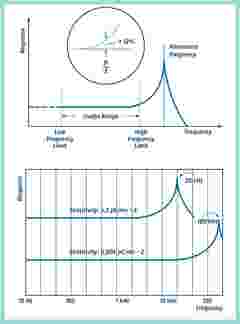
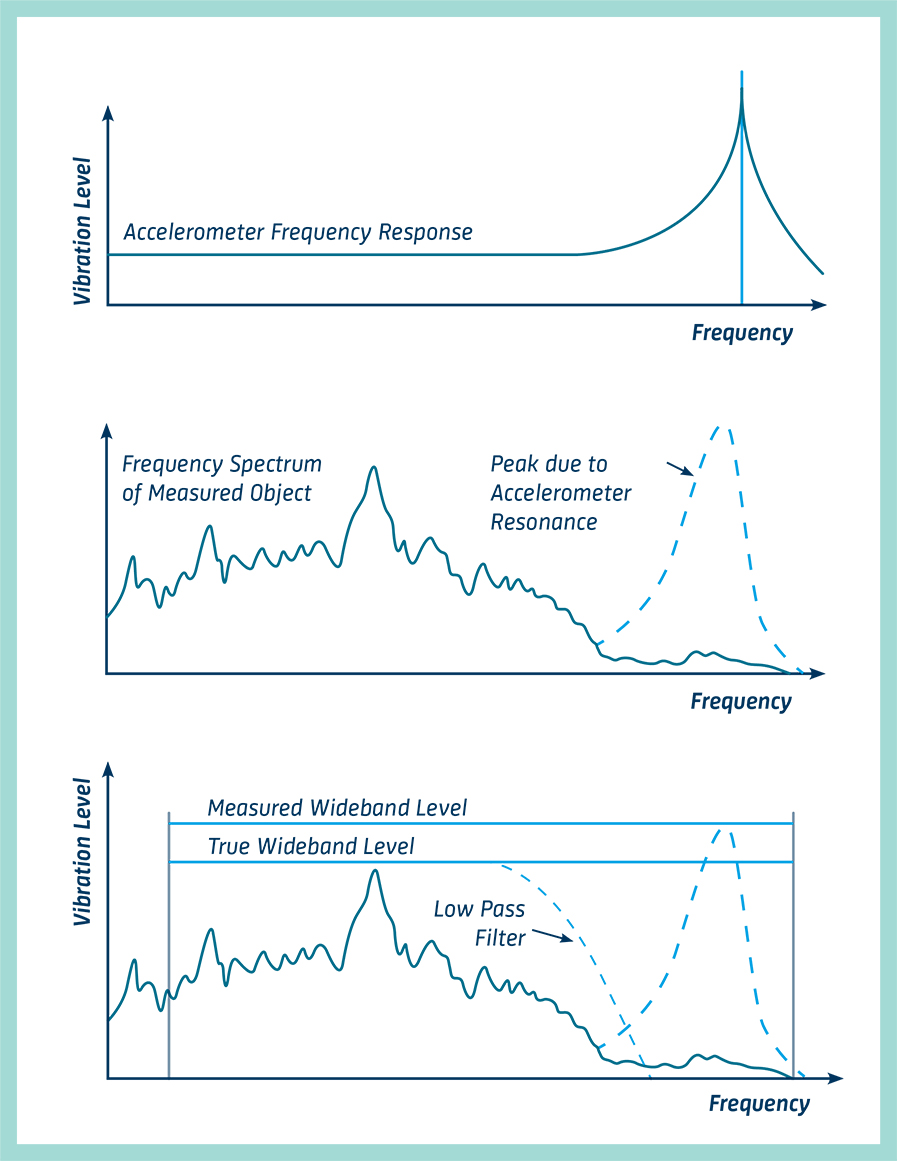
As the accelerometer will typically have an increase in sensitivity at the high-frequency end due to its resonance, its output will not give a true representation of the vibration at the measuring point at these high frequencies.
When frequency analyzing a vibration signal, one may easily recognize that a high-frequency peak is due to the accelerometer resonance, and therefore ignore it. But if an overall wideband reading is taken which includes the accelerometer resonance it will give an inaccurate result if, at the same time, the vibration to be measured also has components in the region around the resonant frequency.
This problem is overcome by choosing an vibration sensor with as wide a frequency range as possible and by using a low-pass filter, which is normally included in vibration meters and preamplifiers, to cut away the undesired signal caused by the accelerometer resonance.
Where measurements are confined to low frequencies. high-frequency vibration and accelerometer resonance effects like overloads on the electronics can be removed with mechanical filters. They consist of a resilient medium, typically rubber, bonded between two mounting discs, which is mounted between the accelerometer and the mounting surface. They will typically reduce the upper-frequency limit to between 0,5 kHz to 5 kHz.