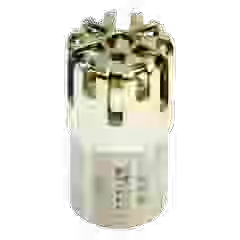
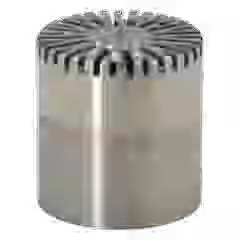
Development of microphone products is performed by a dedicated team of engineers. This is something which is not easy to provide given the relatively small and specialist market for precision microphone products. However, at Brüel & Kjær this investment is seen as essential because it allows the design parameters and physical properties of microphones to be based on a solid foundation of knowledge, skills and experience.
Research and development work also encompasses a number of areas that reflect the different aspects of microphone design and construction, in particular, where highly accurate measurements need to be performed. These include:
- acoustic measurements, such as sound pressure and free-field reciprocity calibration
- mechanical engineering, for example, when controlling small mechanical tolerances
- electrical engineering, such as frequency analysis and capacitance measurements
- environmental testing, such as measurement of resistance to humidity and temperature tests.
Development skills and knowledge are also applied in research into the optimum choice of materials and to devise effective forms of testing microphones before they go into full production.
These tests include resistance to shock, vibration, temperature, humidity and in the case of preamplifiers, resistance to electromagnetic fields is also tested. Bump tests in which the microphone is subjected to repeated knocks simulate everyday use, while shock tests reproduce the possible effect of impacts received in transport (typically up to the equivalent of 1000 m/s2).