
The release of nCode 2026.1 brings new capabilities across GlyphWorks and DesignLife to help engineers process complex data more efficiently, improve fatigue analysis workflows and strengthen traceability across testing and simulation such as:

The CAN Processing glyph has been enhanced for SAE J1939 workflows, including control of the J1939 bit mask with an Auto option, decimal or hexadecimal message ID display, and the ability to exclude empty channels. Together with new support for Peak CAN TRC files and improved Vector MDF CAN bus writing, this helps users process and store CAN data more flexibly and efficiently.
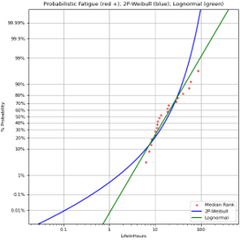
The Weibull Analysis Glyph now supports Normal and LogNormal distributions for curve fitting. This makes it better suited for fitting probabilistic fatigue results, where LogNormal fitting is often more appropriate, and the standard GlyphWorks and DesignLife probabilistic fatigue process flows have been updated accordingly.

The Multi Column Filter glyph now supports list-based row filtering as well as extended column selection syntax, including ranges and wildcards. This simplifies the setup of filtering operations by allowing users to target multiple rows and columns in one configuration rather than building many separate rules.
The Time Series Generator glyph now includes a VibrationInput mode that can automatically set properties using metadata from a Vibration Input glyph connected to a vibration database. This makes it easier to generate signals that conform to the required shock and vibration standards.
The release of nCode 2026.0 brings improvements in functionality and performance for nCode DesignLife, nCode GlyphWorks and nCode VibeSys software products.
This latest version mainly focused on customer requested enhancements, minor bug fixes and component updates for improved security that continue to deliver data-driven confidence through accurate analysis, CAE simulation and several customer-led enhancements such as:
The Strain Life glyph can now use multi-temperature EN materials data with combined stress/strain and temperature histories, matching DesignLife's analysis capabilities. We have also added cycle-by-cycle tracking to both the strain (beta feature) and the stress life glyphs.
The release of nCode 2025.1 brings improvements in functionality and performance for nCode DesignLife, nCode GlyphWorks and nCode VibeSys software products.
This latest version mainly focused on customer requested enhancements, minor bug fixes and component updates for improved security that continue to deliver data-driven confidence through accurate analysis, CAE simulation and several customer-led enhancements such as:
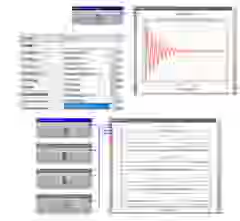
The Stress Life glyph can now use multi-temperature SN materials data to carry out fatigue analyses based on input Stress/Strain and temperature histories. This allows temperature-based fatigue calculations for test data to replicate the calculations already done in DesignLife isothermal analysis using OverallMax, OverallMin, and OverallMedian metrics.
➡️Current customers on active software maintenance can gain access to nCode 2025.1 and its full release documentation using the Support Portal
The release of nCode 2025.0 brings improvements in functionality and performance for nCode DesignLife, nCode GlyphWorks and nCode VibeSys software products.
This latest version mainly focused on customer requested enhancements, minor bug fixes and component updates for improved security that continue to deliver data-driven confidence through accurate analysis, CAE simulation and several customer-led enhancements such as:
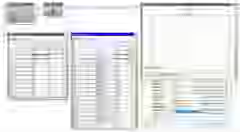
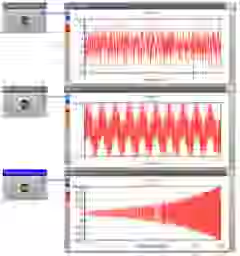
Time Series Generator can now use input metadata and/or multi-column data to set glyph properties and can generate data from Y or XY values. This makes it easier to automate the creation of new time-based data.
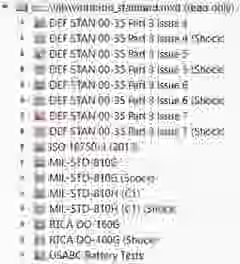
The Vibration Manager database is updated with new versions of military standards including UK Def Stan 00-035 issues 5 and 6. These vibration test specs are used with the Vibration Profile Design product option to compare with shock response spectrum and fatigue damage spectrum from your measured vibration environment and also provides standard inputs to vibration fatigue shaker test simulations (DesignLife).
Python 3.13 support has been added and is now the default. Support for Python 3.8 has been removed, so nCode 2025 now supports 3.11 and 3.13. Since 2008, nCode GlyphWorks has enabled the direct use of Python scripting for ultimate flexibility, beginning with Python support in the Scripting glyph and also allowing customization of fatigue methods within DesignLife. Python versions supported will continue to be updated at major releases.
➡️Current customers on active software maintenance can gain access to nCode 2025.0 and its full release documentation using the Support Portal
The release of nCode 2024.1 introduces enhanced functionality and performance for nCode DesignLife, nCode GlyphWorks, and nCode VibeSys software products. This update includes 155 built-in processing and display glyphs and supports over 50 data formats.
Current customers with active software maintenance can access nCode 2024.1 and the complete release documentation through the Support Portal.
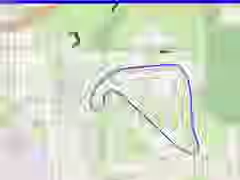
We have now made available our own internet map server for use within the GPS Display glyph. This makes the plotting GPS data on maps much easier and with no extra cost involved.
This avoids the complexity and potential cost of third-party internet map servers. The HBK map server is free to use from within GlyphWorks.
This SN fatigue analysis method uses 4 parameters to describe the fatigue performance of a material. These parameters describe the slope, shape and position of the SN curve. This allows for greater flexibility in material characterization.
The 4-parameter SN method has been available in DesignLife for several releases and has now been made available in Stress Life glyph to allow calculations from measured strains as well as from FE calculated stresses.
The release of nCode 2024.0 brings improvements in functionality and performance for nCode DesignLife, nCode GlyphWorks, and nCode VibeSys software products encompassing 155 built-in processing and display glyphs and support for over 50 data formats.
Current customers on active software maintenance can gain access to nCode 2024.0 and full release documentation using the Support Portal.
The CAN processing glyph can now decode raw CAN data from Vector ASC files. As with the other supported file formats, in combination with a CAN database (.dbc) the raw CAN data is decoded into channels of data in engineering units which can then be processed downstream.
The user can select which channels to be decoded from a list of available channels in order to speed up the extraction. The decoding can be performed in a user-supplied time range, and a time offset can be applied, so the decoded data can be synchronised with additional data from other sources. nCode 2024.0 supports decoding raw CAN data contained in ASAM MDF4 files and HBK catman BIN files as well as the newly supported Vector ASC files.
The TestMatch glyph has been improved with the addition of three new properties. The new properties (CorrelationLimit, YTolerance and XTolerance) allow user control over the convergence of the solution.
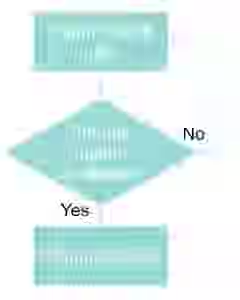
Batch jobs can now be automatically re-submitted after a failure due to license availability. The new functionality is supported in both flowproc and the DesignLife specific dtproc. This feature is controlled by the use of two new command line switches that control the number of re-tries and the time period between the re-tries.
The CAN Processing glyph can be used in conjunction with a CAN database (.dbc file) to decode raw CAN data into channels of data in engineering units, which can then be further processed downstream.
The user can select which channels to be decoded from a list of available channels in order to speed up the extraction. The decoding can be performed in a user-supplied time range, and a time offset can be applied, so the decoded data can be synchronised with additional data from other sources. nCode 2023.1 supports decoding raw CAN data contained in ASAM MDF4 files and HBK catman BIN files.
The TestCombination glyph can now apply time offsets to Time Series and Multi-column input tests. This enables the user to easily synchronize data coming from various sources. This is particularly useful when tests involve multiple data collection devices such as video cameras, CAN loggers, mobile DAQ systems, etc. and the engineer needs to process the entire data for a global understanding of the physical phenomena occurring.
File format enhancements:
This will bring together HBM, Brüel & Kjær, nCode, ReliaSoft, MicroStrain and Discom brands, helping you innovate faster for a cleaner, healthier, and more productive world.