arrow_back_ios

Main Menu

arrow_back_ios

Main Menu

arrow_back_ios

Main Menu

usp-icon

In a highly competitive global environment, increasing machining productivity is essential to reduce the cost of critical mechanical components. However, the increase in thermal and mechanical damages generated during machining can reduce their service life. Today, these detrimental effects cannot efficiently be integrated into fatigue life calculations.

usp-icon

MISUTECH and HBK have developed an interface between their software solutions, MISULAB® and nCode DesignLife, to bridge the gap between industrialization teams and fatigue analysis engineers.

usp-icon

Integration of the machined material state into durability assessments, enabling the simultaneous optimisation of machining costs and component strength.

The Challenge

For decades, it has been well established that, within just a few milliseconds, machining subjects materials to extreme plastic deformation and temperature rises of several hundred degrees Celsius, profoundly altering surface integrity. According to the U.S. Federal Aviation Administration (FAA), 25% of accidents are caused by inappropriate machining operations, such as incorrect selection of cutting conditions or premature tool wear.

MISUTECH has now developed MISULAB®, the first numerical simulation software capable of rapidly predicting the impact of machining processes on surface regions where crack initiation occurs. In particular, the residual stress state plays a key role. Machining-induced residual stresses superimpose on the in-service stresses experienced by the component within its mechanical system and can either enhance or degrade its durability.

However, MISULAB® is not able to directly predict the influence of machining on the component’s fatigue life. This limitation represented an obstacle to optimizing machining conditions - such as adopting new cutting tools, increasing productivity, or eliminating polluting cutting fluids - while still meeting fatigue life requirements.

The Solution

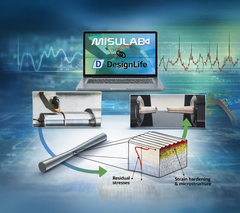
HBK provides nCode DesignLife, a leading software solution for predicting the fatigue performance of mechanical components. In collaboration with HBK, MISUTECH has seamlessly interfaced MISULAB® with nCode DesignLife, creating a unique link between machining simulation and fatigue analysis. This combined solution enables the simulation of machining-induced residual stresses and the direct assessment of their impact on fatigue life. The 3D residual stress fields computed by MISULAB® are directly transferred to nCode DesignLife, together with mechanical loading conditions, delivering a significantly more accurate and reliable prediction of component service life.

It is now possible to rapidly assess the impact of multiple machining strategies on the fatigue performance of a component - without carrying out machining trials or long and costly fatigue tests. Within just a few hours, a new generation of cutting tools with strong productivity potential can be evaluated before any modification of production conditions is implemented on the shop floor. This approach also makes it possible to increase fatigue strength by optimizing machining parameters using existing machining solutions.

Results & Impact

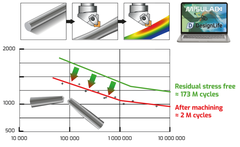
It was demonstrated that the turning conditions routinely applied by an aerospace machining supplier generated high tensile residual stresses at the surface, reducing the fatigue life of a 15-5PH stainless steel power transmission shaft by a factor of 100 compared with an optimized machining process producing no residual stresses.

Conclusion

Through the interface between MISULAB® and nCode DesignLife, MISUTECH and HBK are now able to jointly support their customers in increasing production competitiveness while reducing the risk of premature failures of critical parts. 

MISULAB software from Misutech is developed in partnership with major aerospace contractors and CETIM.

Misulab figure

Technology Used