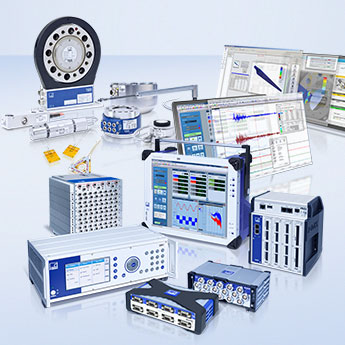
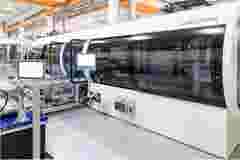
The HBK Electric Powertrain Testing Solution gives automotive manufacturers and Tier 1 suppliers a suite of sophisticated real-time test and measurement tools to streamline the evaluation process and provide actionable insights quickly and effectively. Our best-in-class electric powertrain testing equipment minimises measurement uncertainty, delivering reliable results for optimising drivetrain efficiency and performance to ultimately improve the driver experience.
Understanding and optimising the behaviour of a complete powertrain – typically from the power source (or emulator) to the wheel flange – requires engineers who go beyond HIL simulation and perform physical testing on components as manufactured. Bench testing verifies the design parameters provided by virtual simulation; validates the interaction between the sub-systems; and calibrates the system and its controls. The insights gained enable engineers to optimise the drivetrain efficiency and performance before mass production begins.
The Electric Powertrain Testing Solution offered by HBK is a combination of sensors, instruments, and software that enables analysis of electric vehicle (EV) powertrains as integrated systems. It enables engineers to address the complexity of hybrid and EV powertrains; meet the new challenges for their validation; and deliver the test and analysis techniques necessary for their evaluation and optimisation.
At the same time, HBK has designed the Electric Powertrain Testing Solution to address the economic realities of electric vehicle development. The HBK powertrain testing environment provides automotive test engineers with rapid set-up; accurate and precise data for reliable analysis; effective data collection, storage, and transfer strategies; actionable analysis capabilities; and cost-effective integration into IT systems, as well as the corporate product development process.
Electric powertrains are used in vehicles of all scales: from sub-compact to performance passenger cars; from light vans to articulated 16-wheelers; from forklifts to excavator for off-road and construction vehicles.
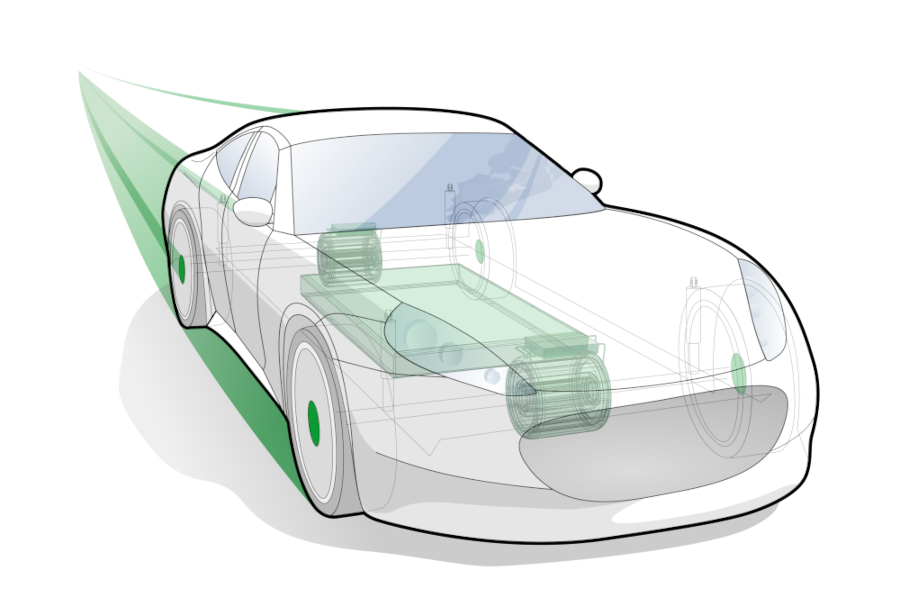
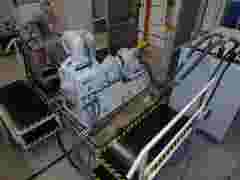
Even in vehicles of the same type, the concept of an electric powertrain is often implemented in different ways. In passenger cars, for example, the scope of the powertrain under test may range from a single e-axle with two driven wheels, through dual e-axle with four driven wheels, to two (or more) individual hub motors. Powertrain analysis on a static test rig may therefore involve between one and four motors, between one and four inverters, and between two and four dynamometers. The sheer variety of contemporary electric powertrain designs requires a drivetrain test and measurement solution that is both flexible and extensible.
A wide range of issues are examined during electric powertrain testing, primarily aimed at optimising performance while minimizing power consumption:
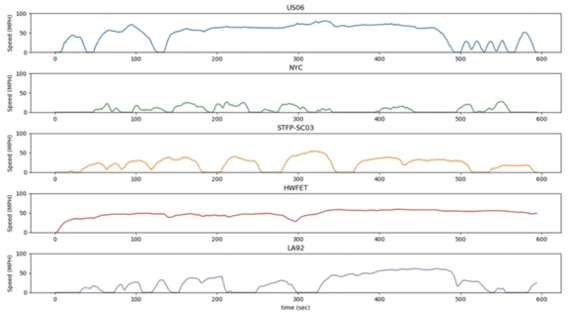
The distinguishing characteristic of the HBK solution is that it measures dynamic power accurately during transients. The load-steps, run-ups, and run-downs that characterise the standard drive cycles of the US Environmental Protection Agency (EPA) test and European WLTP (Worldwide Harmonised Light Vehicle Test Procedure) are the very reason why inverter-controlled electric motors are used for EV powertrains.
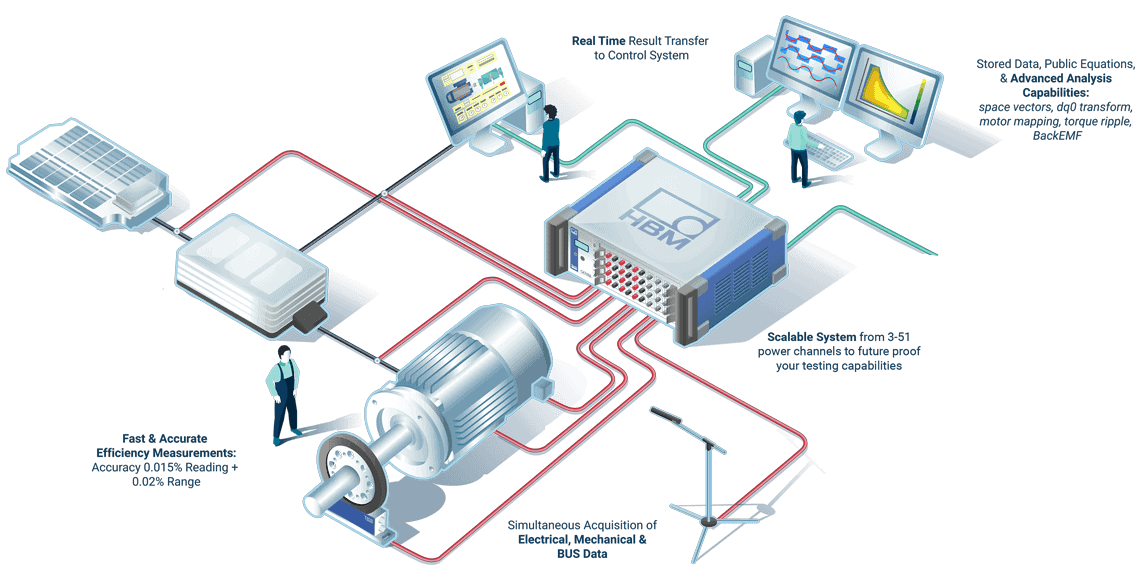
The HBK Electric Powertrain Testing Solution measures and captures both electrical and mechanical signals, plus ECU and CAN bus signals simultaneously, and on a single time trace. Inputs can be compared with outputs to calculate efficiency; and losses can be unambiguously traced to their cause; and the downstream effects off issues such as temperature or NVH on other sub-systems can be examined.
The HBK Electric Powertrain Testing Solution is more than a combination of sensors, instruments, and software that has proven to work effectively together. It streamlines understanding and enables engineers to act on insights and bring vehicles to market sooner.
The heart of the HBK Electric Powertrain Testing Solution is the GENESIS HighSpeed series of mainframes. This is a modular platform that measures both mechanical and electrical signals and functions as a power analyzer, transient recorder, scope, and data acquisition system all-in-one.
The range comprises five models. Two portable instruments with high resolution touchscreens are designed for bench top use. Three tethered instruments are available for rack mounting and can be used with or without a PC. These mainframes can be used in stand-alone mode, as a single mainframe or combined with other mainframes via ethernet for unlimited scalability. Each instrument provides from 2 to 17 input card slots for ‘plug-and-play’ flexibility.
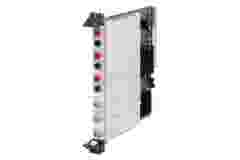
For electric powertrain analysis, the base configuration uses one or more GN310B ‘Power Analyzer’ cards. Each GN310B accepts 3 power channels (5 voltage ranges to ± 1500 V DC and 7 current ranges starting at ± 75 mA to ± 2 A) plus 2 digital channels for torque and speed. It provides real-time computations of RMS, P, S, Q, λ, η, cosϕ, THD, i_alpha, i_ beta (and more) with full bandwidth power calculations and fundamental power calculations.
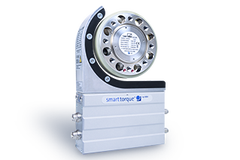
Torque measurements are provided by the range of HBK torque flange transducers. The T40B, for example, is a universal stand-alone torque transducer, which transmits measured values as digital signals across a range of nominal (rated) torques: 100 Nm, 200 Nm, 500 Nm, 1 kNm, 2 kNm, 3 kNm,5 kNm and 10 kNm. The T40B is optionally available with a time signal (rotational speed) for dq0 analysis and enables torque ripple analysis.
For exceptional precision at high rotational speeds up to 22.000 rpm, the T12HP torque transducer delivers precise values over the entire measurement range from 100Nm to 10.000Nm, without the need to switch the measuring range (like so-called dual range sensors).
Free slots in the mainframes are then equipped with additional cards to extend the scope of analysis to include, say, temperature or NVH. The universal data acquisition cards, for example, are available for 8 or 16 channels. Each input supports 9 different sensor types and is perfectly suited for dynamic mechanical testing. The high sample rate of 500 kS/s per channel and 24-bit resolution, makes it the perfect solution for recording mechanical test signals via microphones, accelerometers, or thermocouples.
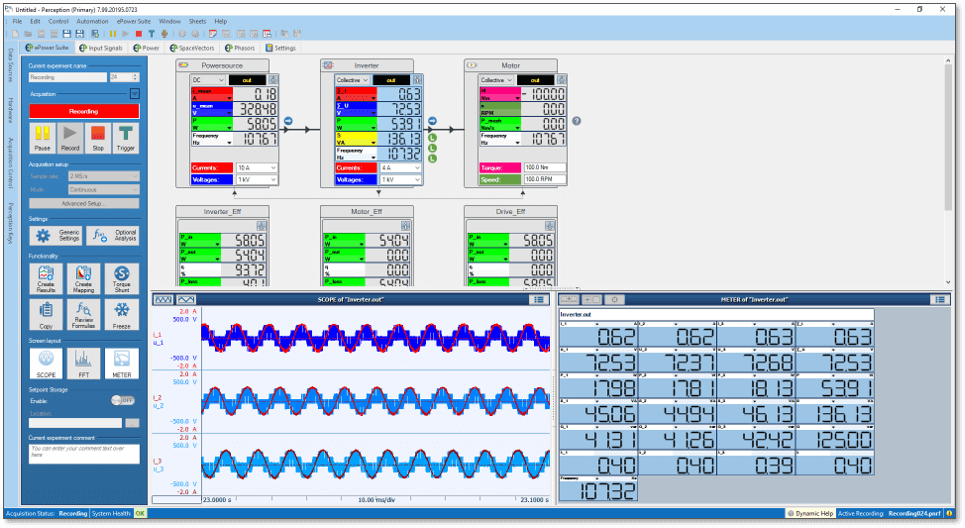
The user controls the Electric Powertrain Testing Solution via HBK’s Perception software. This sophisticated software environment covers the complete drivetrain testing process from bench set-up through to production of customised reports; and the entire scope of the powertrain under test, from battery (or emulator) through inverter, machine, and driveshaft, to the wheel flange.
The interface has been designed by UI experts to allow engineers to operate the full functionality of the power analyzer easily. With just a mouse click, users can toggle between the functions of a DAQ for raw data acquisition, a scope, or an FFT analyzer. Rapid visualisation (up to 10 GB in 10 seconds) and multi-monitor capabilities allow users to display this information across as many screens as their PC will support.
Perception software is designed for high-speed data acquisition (400 MB/s). It also provides fast and reliable processing of large amounts of data – and does both simultaneously. Engineers can access and visualise saved data even while electric powertrain measurements are running, for real-time management and optimisation of experiments.
By combining raw data acquisition with real-time power calculation, Perception enables engineers to confirm – live and on-screen – that the design or parameters for any drivetrain experiment are correctly defined. This intuitive feedback loop maximises engineer productivity.
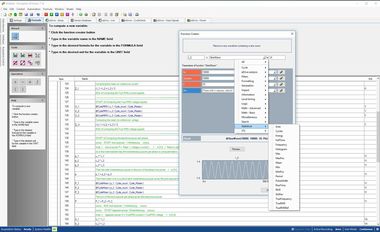
A key feature of Perception is the database of over 100 pre-defined formulas which include advanced analyses like space vector- or dq0-transformation (aka Park transformation). The database can be further expanded with user defined formulae, created on the fly or by combining elements from selection lists.
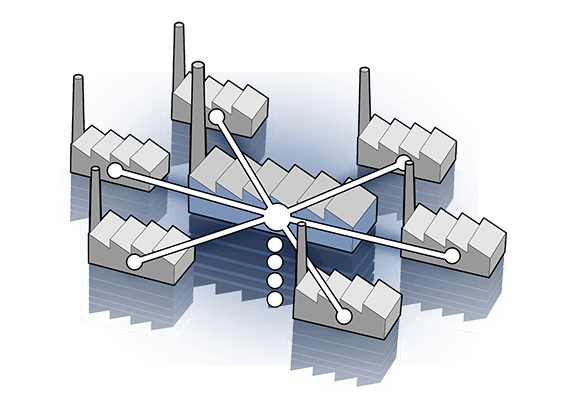
Batch processing of saved data via Perception allows engineers to perform post-process analyses for verification and certification without the time and effort of redoing a test. Last, but by no means least, Perception allows engineers to transfer the data from secure Linux RAID arrays to popular 3rd party software systems like nCode GlyphWorks, Matlab or LabVIEW.
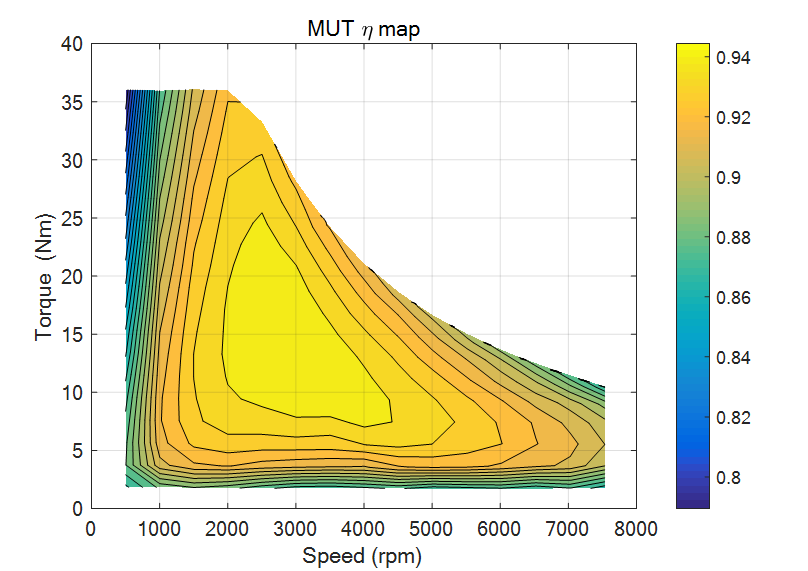
Efficiency maps are a standard method for gaining insights into the opportunities for optimising an electric powertrain. The process of observing, recording, and analysing the behaviour of the powertrain as a complete system across multiple speed and load conditions means performing multiple sets of iterative test loops as swiftly as possible. In practice, automated test management is essential.
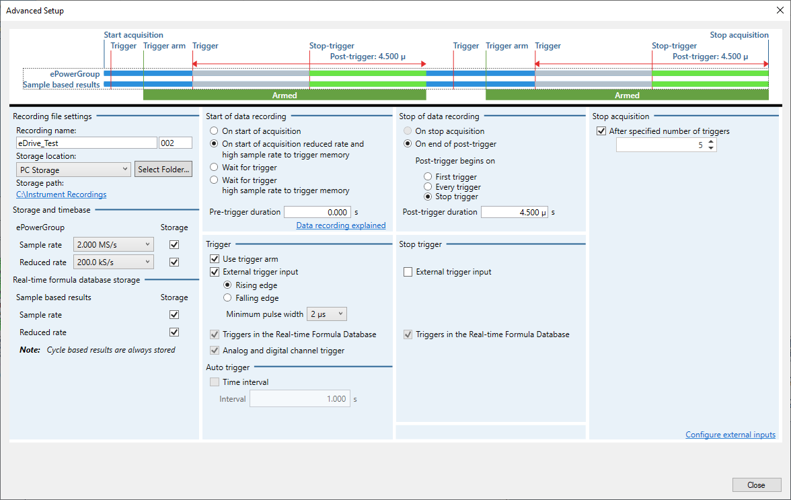
In the HBK Electric Powertrain Testing Solution, automation is provided by Perception software. The start and finish of the set point is defined by the user via keys and macros, as are automated test and analysis sequences. The series of triggers can be controlled manually, via software or via TTL remote control. At run time, Perception automates the data collection for each of the thousands of set points. The real-time storage capabilities of the Genesis HighSpeed mainframe and the ability to record triggers without dead time in between, means that the process of acquiring raw data, plus computing and visualising the results for a motor map, can be done in a few minutes. This approach significantly reduces staff effort and ensures production of each map in a shorter elapsed time.
Additional techniques in the new version of Perception accelerate the production of surface maps.
In addition to automating the processes of data measurement and acquisition, Perception allows engineers to automate data export, analysis, or report generation.
A primary criterion for choosing the HBK Electric Powertrain Testing Solution is that it delivers accurate, precise, and highly granular data that promotes a deeper understanding of the machine under test.
A deeper understanding of the machine under test in turn leads to better questions for optimising EV drivetrains and providing unprecedented levels of powertrain control.
The economics of vehicle development are constantly changing. The introduction of electric powertrains has removed some issues (exhaust emissions, engine noise) and highlighted new ones (inverter whine, gearbox whine). Some issues that existed before (incompatibilities between components or sub-systems, imperfections caused by design, loading or temperature effects, or manufacturing variations) now appear in a new format.
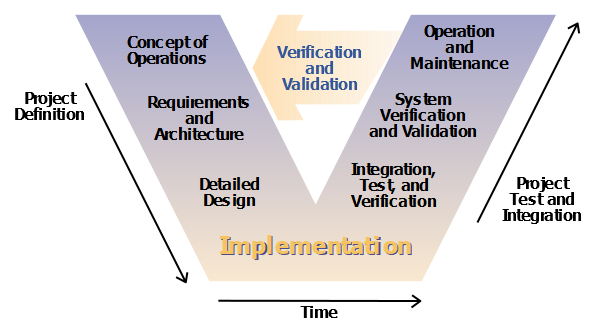
Increasingly, automotive OEMs and the Tier 1 suppliers that support them seek to achieve economic efficiencies and shorter time to market by front-loading the development cycle. The practical impact is that electric powertrain testing departments are adapting their procedures and testing methodologies to cope with these new challenges. The HBK Electric Powertrain Testing Solution is aligned with these transitions in the automotive product development process: the focus is on rapid set-up; increasing the speed of insight; supporting data strategies; the product development process; and workplace safety.
When managing the drivetrain testing process, engineers need to integrate a wide variety of test bench tools: sensors for both electrical and mechanical signals, automation PCs, power analyzers, DAQ systems for signals like temperature or NVH, software for analysis and visualisation, and so on. Any incompatibilities between sensors, instruments and software will simply consume staff resources unnecessarily.
HBK products on the other hand, are designed and built for interoperability: sensors and instruments are integrated by design. The ‘plug-and-play’ approach ensures that individual components of the measurement chain are simple to integrate. Sourcing minor but essential cables or consumables from HBK ensures high signal quality and protects staff productivity.
Perception software, too, is designed to enhance engineer productivity during test-bench set-up:
The Electric Powertrain Testing Solution is built from the ground-up with best-in-class products that deliver the highest possible accuracy to ensure reliable results. Modular design and assured integration of components ensure a ‘no-sweat’ installation. Solutions are flexible and easily extended, guaranteeing a long-term return on investment.

The objective of the HBK Electric Powertrain Testing Solution is to help engineers understand the performance, the losses, and the efficiency of electromechanical systems more quickly and accurately than ever before.
HBK therefore adapts its measurement techniques to acquire high quality data. For example: faster acquisition of static setpoints for more efficient production of motor maps; data collection on the half-cycle to provide dynamic acquisition of accurate data during transients.
When assessing drivetrain performance, acquiring electrical and mechanical signals simultaneously saves time and effort while reducing unnecessary errors caused by component incompatibility. The HBK Electric Powertrain Testing Solution also supports effective data strategies such as synchronisation of signals and data transfer:
EV characteristics continue to evolve in response to customer needs. Noticeable trends include higher voltages for electric powertrains. The current interest in transition from 400V to 800V systems seems to be largely driven by a desire for shorter charge times. The implication for product development is that test bench equipment needs to be safety rated accordingly.
In the HBK solution:
HBK offers standardized and individual knowledge transfer to ensure your professionals become productive as quickly as possible. Training sessions can be delivered online or held either at your premises or at the HBK Academy training rooms.
Training and education content can be customized to address specific needs: