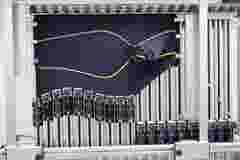
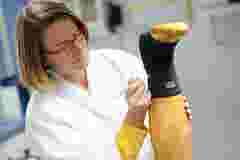
In the beginning of the 1980s, the HOHENSTEIN experts developed the HOhenstein SYstem (HOSY) for the testing of the impact of medical compression wear. Meanwhile, HOSY has established the standard in compression wear testing and has become the mandatory testing system for compliance with different standards such as RAL and DIN. HOHENSTEIN utilizes the system for its in-house textile testing services and also sells it to customers.
“HBK technology has always been integrated into the HOSY,” explains Gunther Kretzschmar, who has worked for HBK Sales and has also been the contact for Hohenstein for over 20 years.
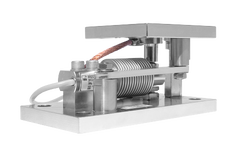
HOHENSTEIN has now enhanced its testing system to meet an increased number of individual customer requirements and to make the HOSY compatible with IIoT (Industrial Internet of Things) applications. In doing so, the company has outlined specific requirements for the digital sensors that measure force. “The sensors must be very precise to enable us to obtain accurate measurement results,” explains Florian Girmond. Additionally, the individual sensors need to be narrow to ensure that a maximum width of 5 centimeters, including the mount for the textile jig, is not exceeded. It is also essential that the sensors have a high overload stability to avoid damage to the sensors in the event of unexpected load peaks. The sensors are compatible with the CAN bus technology applied in the testing system due to their CAN bus interface. Hence, they are a perfect fit for the new HOSYcan and can transfer the measured data quickly and efficiently to the software, which, in turn, calculates and visualizes the compression. “FIT5A is the digital sensor that matches our high demands,” says Florian Girmond.