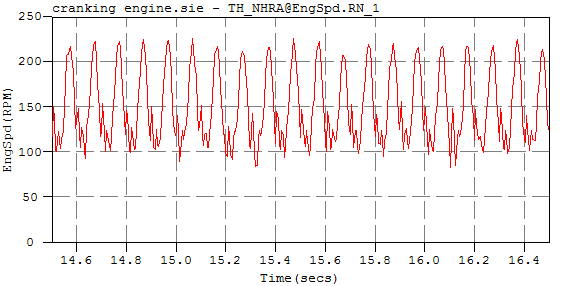
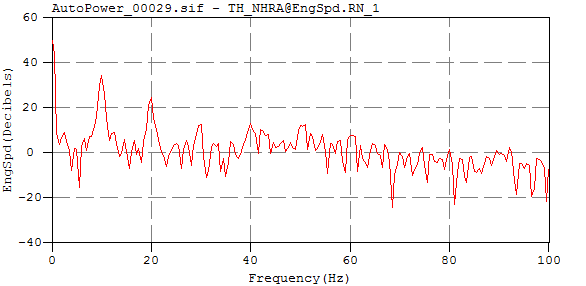
Another way to analyze the performance of the engine is to perform a frequency analysis of the engine speed signal. Figure 4 shows a plot of this analysis. The most significant frequency is 10 Hz. This is equivalent to the firing frequency of an 8 cylinder, 4 stroke engine at 150 rpm. This is called the 4
th order effect because it happens four times per crankshaft revolution.
The second most significant frequency component is 20 Hz. This frequency component is an 8
th order effect and is due to the dynamics of the eight cylinders in the engine. These dynamic effects occur because the crankshaft speed slows during each cylinder compression. Although these dynamic variations are common, they can possibly be reduced by adding more inertia to the flywheel/torque convertor assembly.
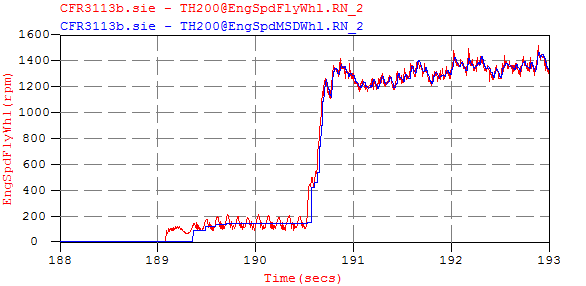
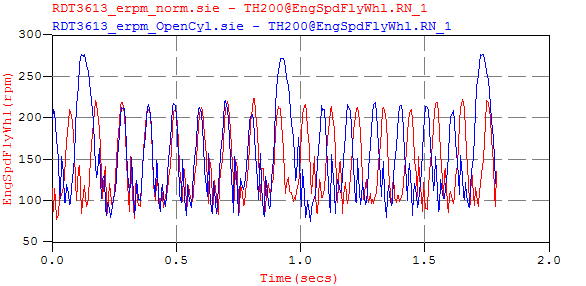
As a result of his investigations, Thompson determined that the average cranking speed of 150 rpm might be too slow to have good startups. At this point, there are several things one can do to increase this speed, including:
- Install a more powerful starter motor,
- Increase battery power,
- Use larger battery cables to avoid voltage drops, and
- Ensure that there is a solid ground from battery to starter.